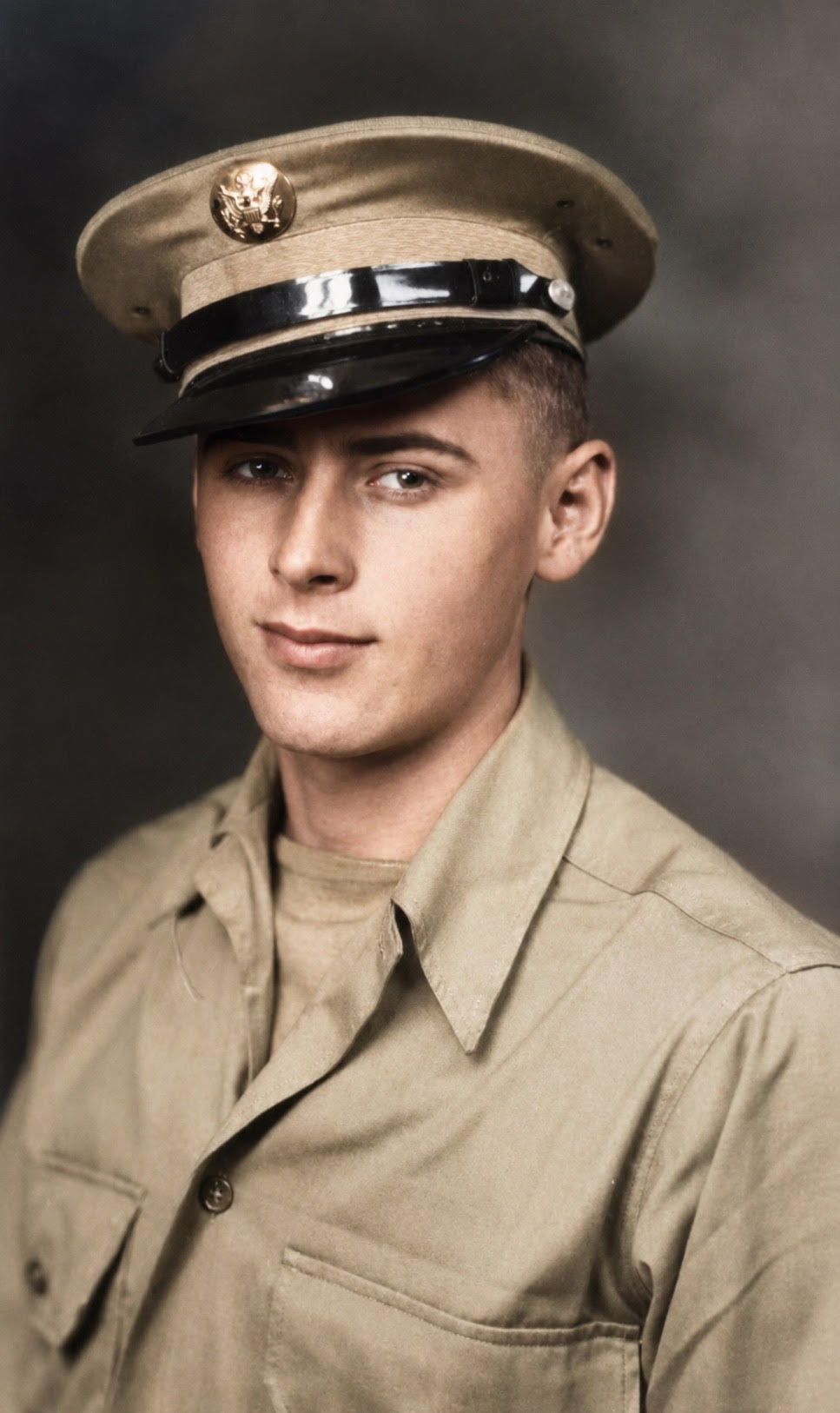
Technician Fifth Grade (T-5) · Signal Corps · 3255th Signal Service Company
Army Serial Number 35 892 966 • 1943 – 1946
Born
June 15, 1925
Hometown
Clinton, Indiana
Entered service
Sept 8, 1943
Branch
Signal Corps
Overseas
ETO, 1944–45
Discharged
Jan 5, 1946
This is the reconstructed wartime journey of James E. Procarione — from a draftee in
Indiana, through medical training in Texas and the Signal Corps in Virginia, across the Atlantic to
England, and on through four campaigns in Europe to victory and home. Because his main personnel file
was almost certainly lost in the 1973 National Personnel Records Center fire, this timeline was rebuilt
record-by-record from his county-recorded discharge and from the U.S. Army's daily Morning Reports,
found by his service number, 35 892 966.
Indiana → Texas → Virginia → England → France · Luxembourg · Germany → Home
Map of Service
From a draftee in Indiana, across the United States, over the Atlantic, and through
the campaigns of Europe — and home again. The numbered stops match the timeline entries below; the two
panels magnify the boxed areas. Coastlines and boundaries drawn from Natural Earth.
1Clinton, Indiana Born — June 15, 1925
2Indianapolis, Indiana Entered active service — Sept 8, 1943
3Camp Barkeley, Texas Medical training — Sept 1943
4Vint Hill Farms, Virginia 2nd Signal Service Bn. — Jan 1944
⚓ Atlantic crossing — sailed February 9, 1944 ⚓
5Lichfield, England 10th Replacement Depot — Feb 1944
6London, England 118th Signal Radio Intelligence Co. — Apr 1944
7Northern France & Lorraine Le Mans · Nancy · Château-Salins — 1944
8Kirchberg, Luxembourg The Ardennes / Battle of the Bulge — Dec 1944–Jan 1945
9Across Germany to Austria Langenzenn · Linz — to V‑E Day, 1945
⚓ Homeward — departed Europe December 18, 1945 ⚓
10Camp Atterbury, Indiana Honorably discharged — Jan 5, 1946
Service Timeline
Family record
June 15, 1925
Born in Clinton, Indiana
James Eugene Procarione is born in Clinton, Vermillion County, Indiana, son of Domenic Procarione.
Context / in progress
April 1930
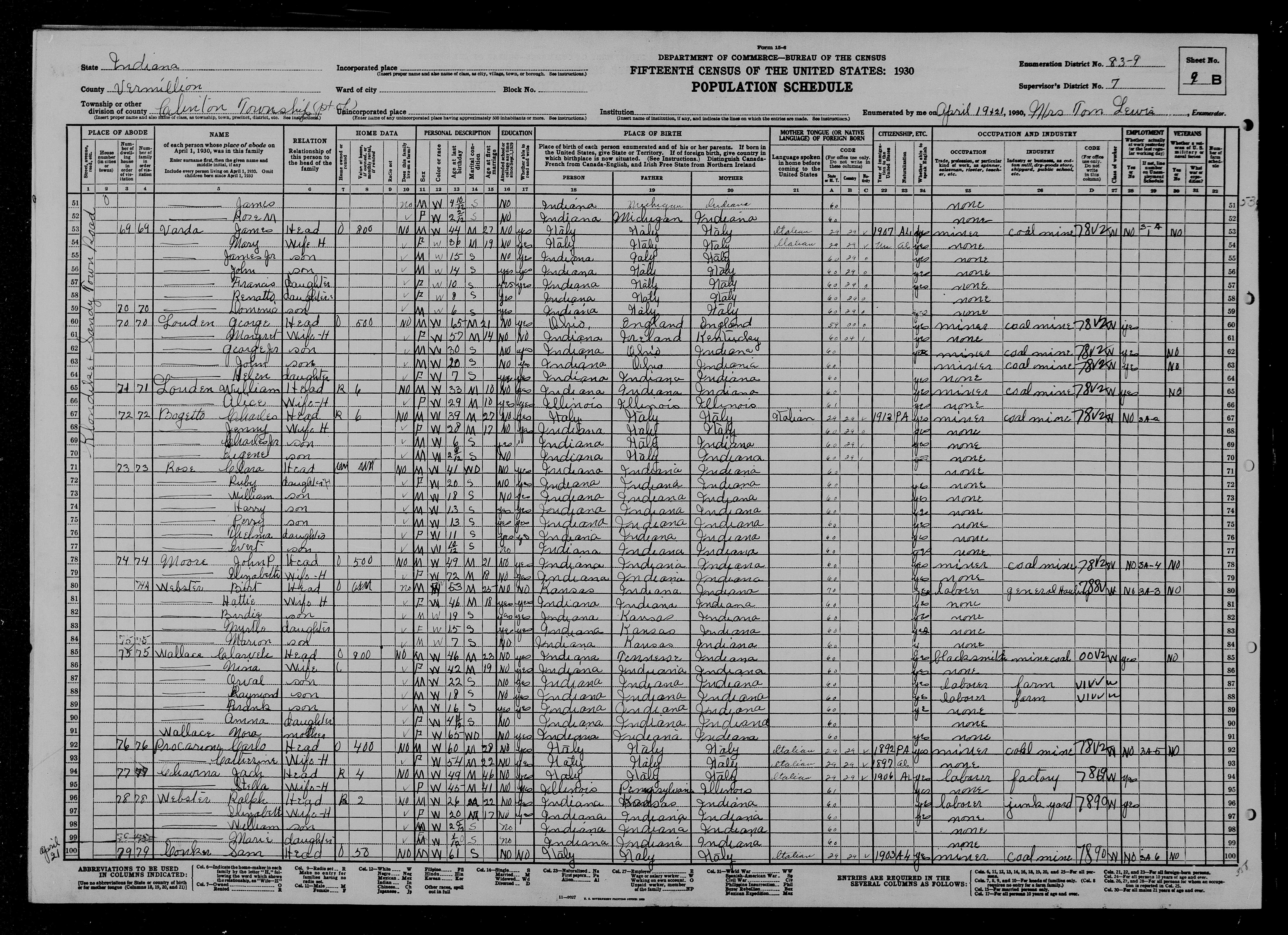
A small boy in Clinton — the 1930 Census
The earliest record of James yet found: the 1930 federal census lists him as a four-year-old in the Procarione household in Clinton Township, Vermillion County (the east part, outside Clinton city), among the Italian-immigrant coal-mining families of the district. It pushes the documented family back a full decade before the 1940 census. Newly discovered.
The 1930 census sheet — James, age 4, and his little sister Rose M. at lines 51–52, the top of Sheet 9-B: the family's entry carries over from the bottom of the previous sheet. Clinton Township, Vermillion County, Indiana.
Source: 1930 U.S. Census — Indiana, Vermillion County, Clinton Township, E.D. 83-9, Sheet 9-B (NARA RG 29, Publication T626, NAID 598030; image via FamilySearch)
Context / in progress
April 30, 1940
A teenager at home in Clinton — the 1940 Census
The federal census finds James, age 14 and in high school, living with his family on RR 3 just outside Clinton (Crompton Hill): father Dominik (40, born in Michigan, working as a laborer on a government road project), mother Julia (31), and younger sister Rosemary (12). The family had lived in the same house since at least 1935, in a neighborhood full of Italian-immigrant coal-mining families. Newly discovered — his mother and sister are documented here for the first time.
Source: 1940 U.S. Census — Indiana, Vermillion County, Clinton Township, E.D. 83-9, Sheet 12-A (NARA RG 29, NAID 131722855)
Context / in progress
June 16, 1943
Registers for the draft — the day after he turned 18
One day after his eighteenth birthday, James registers for the World War II draft at Local Board No. 1, at the Vermillion County courthouse in Newport, Indiana (serial W-176, order 11794). In his own hand the card records the civilian life he was about to leave: he lived on RR 3, Clinton; the person who would always know his address was his father, Mr. Domenic Procarione; and he was working in the dairy industry, for John Aimone. The registrar's description on the back: 5 ft 7 in, 140 lbs, blue eyes, blond hair, light complexion. Two months later he was inducted. Newly discovered.
Source: WWII Draft Registration Card (DSS Form 1) — Local Board No. 1, Vermillion County, Indiana, registered 16 June 1943 (Fold3 / Ancestry index; NARA RG 147, WWII Draft Registration Cards for Indiana)
Confirmed — Discharge
August 18, 1943
Inducted into the U.S. Army
At age 18, inducted through Local Draft Board #1, Vermillion County, Indiana. His surviving Army enlistment record independently confirms this date and the entry at Indianapolis, Indiana, and adds a few personal details the discharge never carried: he entered straight from civilian life as a Selective Service draftee, and was a high-school graduate (four years of high school). Newly discovered.
Source: Honorable Discharge (WD AGO Form 53-55); WWII Army Enlistment Record (NARA AAD — Electronic Army Serial Number Merged File, RG 64)
Confirmed — Discharge
September 8, 1943
Entered active service — Indianapolis, Indiana
Reported for active duty at Indianapolis. His discharge explains the three-week gap since his August 18 induction: from 18 August to 7 September 1943 he was carried in the Enlisted Reserve Corps on inactive status — drafted and sworn but still a civilian at home — and was called to active service on 8 September. Newly transcribed from the discharge.
Source: Honorable Discharge (WD AGO Form 53-55), Remarks (“Inactive Service in ERC 18 Aug 43 thru 7 Sep 43”)
Confirmed — Army Morning Report
September 13, 1943
Fort Benjamin Harrison, Indiana — the Reception Center
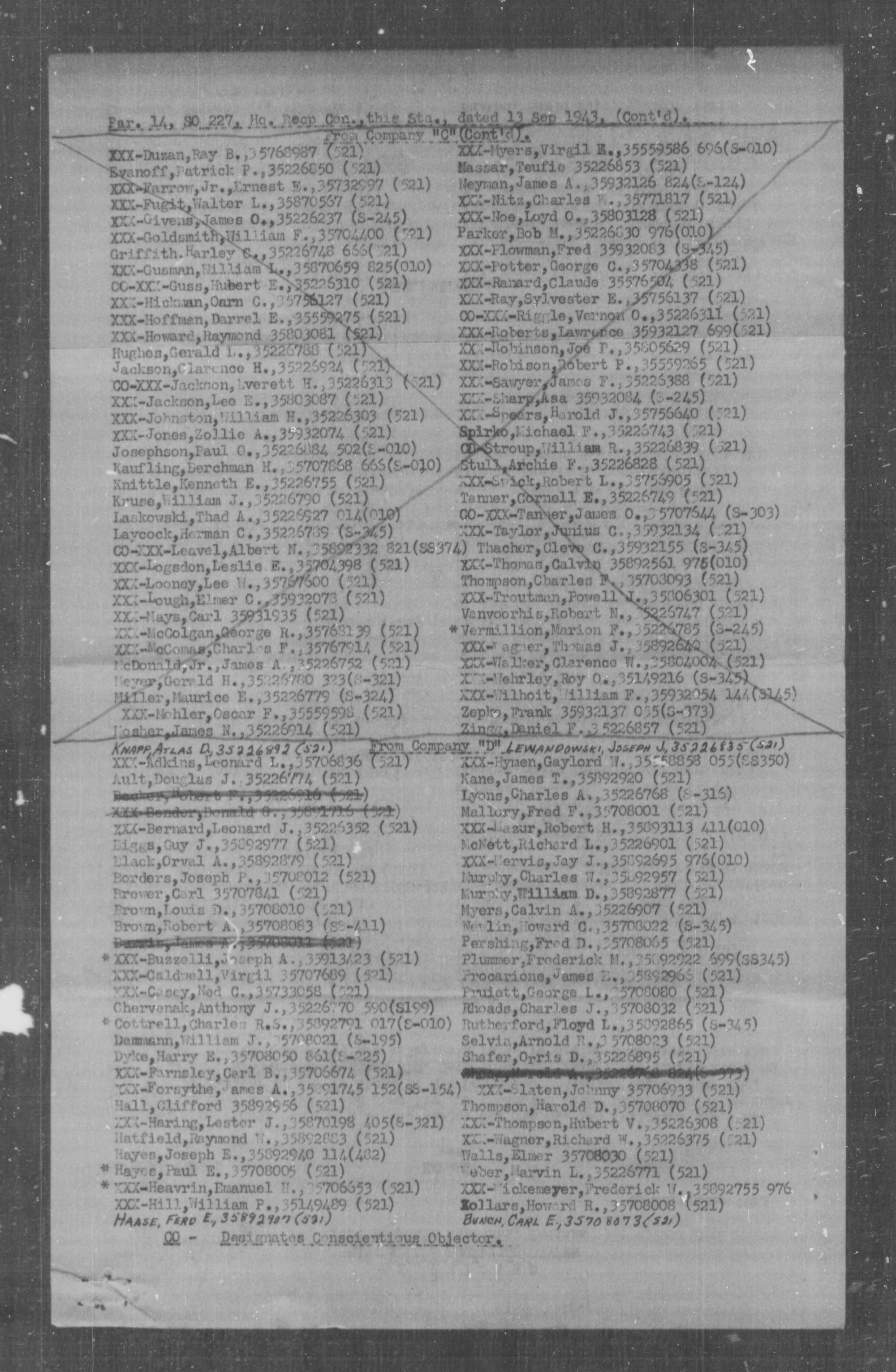
His very first days as a soldier. Five days after entering active service at Indianapolis, James is at the Reception Center at Fort Benjamin Harrison, carried in Company “C” — the place new draftees were issued uniforms, tested, classified and shipped out to training. A typed roster of Special Orders No. 227, 13 September 1943 lists him with the code (521) beside his name: basic — a soldier not yet trained for anything in particular. Within days he would be on a train to Texas.
Two names in the same column would follow him a very long way: Marion F. Vermillion and Roy O. Wehrley are on this Indiana roster in September 1943 — and both are still beside him twenty months later, in England, on the order that sends him to the 3255th Signal Service Company. They were together nearly from the first day.Newly discovered.
The reception-center roster, Fort Benjamin Harrison, 13 September 1943 — “Procarione, James E., 35892966 (521).”
Source: Special Orders No. 227, par. 14, Headquarters Reception Center, Fort Benjamin Harrison, Indiana, 13 September 1943 (NARA Roll 87, Sept 1943, image 752)
Confirmed — Army Morning Report
September 17, 1943
Camp Barkeley, Texas — Medical Replacement Training
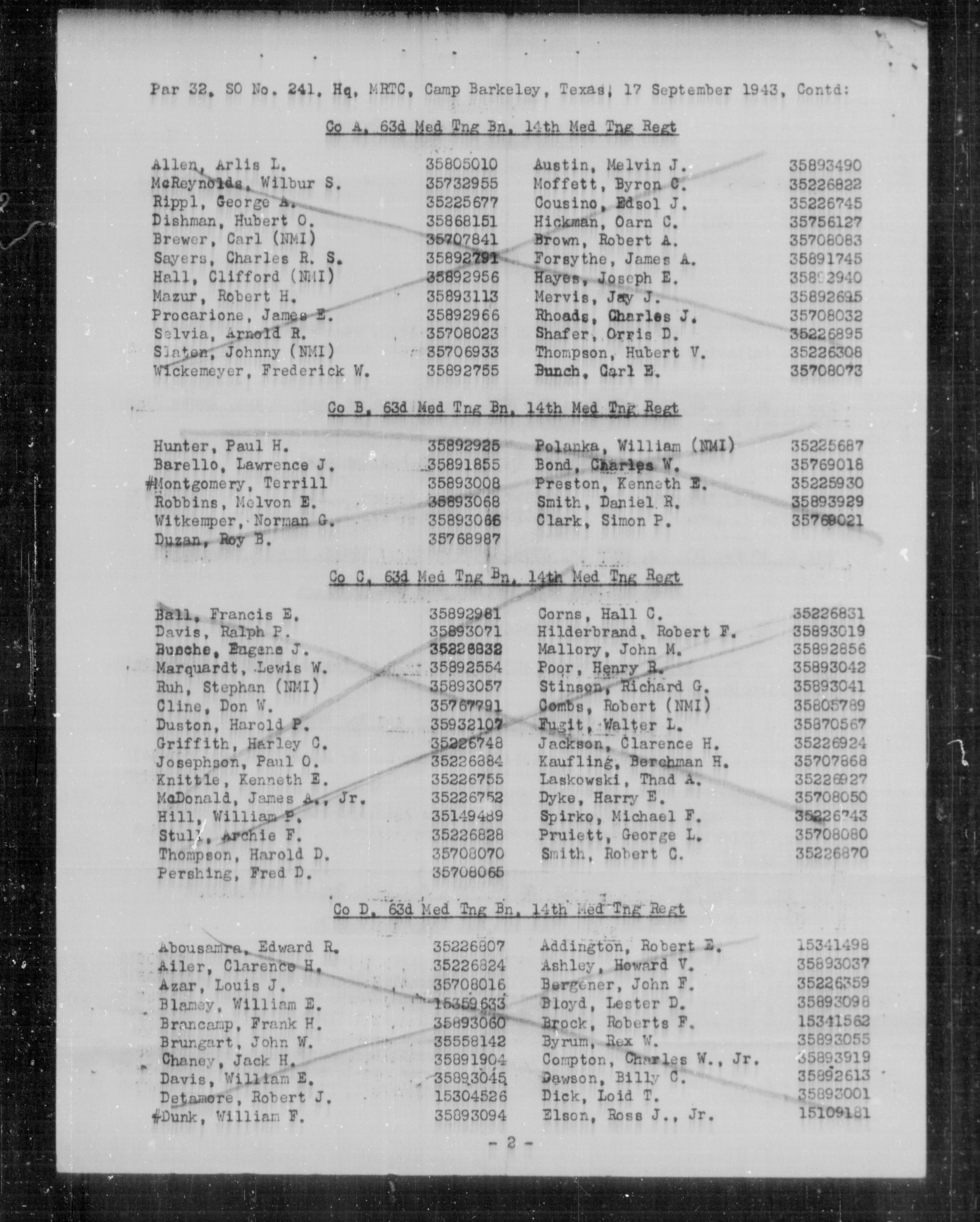
Assigned to Company A, 63rd Medical Training Battalion, 14th Medical Training Regiment at the Medical Replacement Training Center. James's Army career began in medical training — a detail his discharge never recorded. Newly discovered.
His line in Special Order 241 — Camp Barkeley, Texas, 17 Sept 1943.
Source: Morning Report — Special Order 241, Hq MRTC (NARA Roll 66, Sept 1943)
Context / in progress
Mid–late December 1943
Leaving Camp Barkeley — toward the Signal Corps
By mid-December 1943, trainees at Camp Barkeley were being staged northward (Special Order 320, 14 Dec 1943, moved a 400-man group toward Camp Reynolds, Pennsylvania). Around this period James was reclassified from medical training into the Signal Corps. His exact transfer record is still being searched.
Source: Context — Camp Barkeley Morning Reports, Dec 1943 (his specific line not yet isolated)
Confirmed — Army Morning Report
c. January 8–9, 1944
Vint Hill Farms Station, Virginia — 2nd Signal Service Battalion
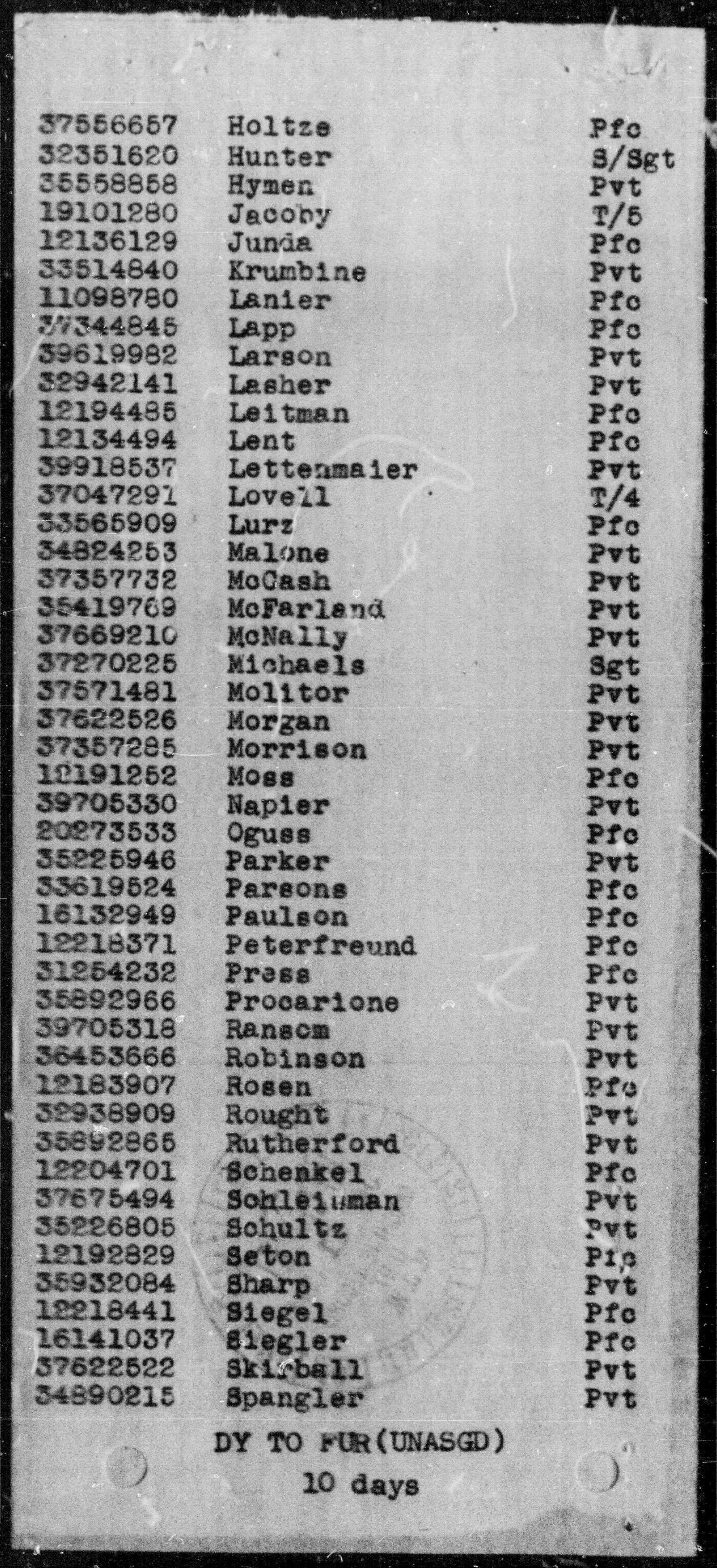
Now in the Signal Corps, attached to the 2nd Signal Service Battalion at Vint Hill Farms Station, Warrenton, Virginia — the U.S. Army's WWII signals-intelligence station. He is granted a 10-day furlough — the customary leave home before shipping overseas. Newly discovered.
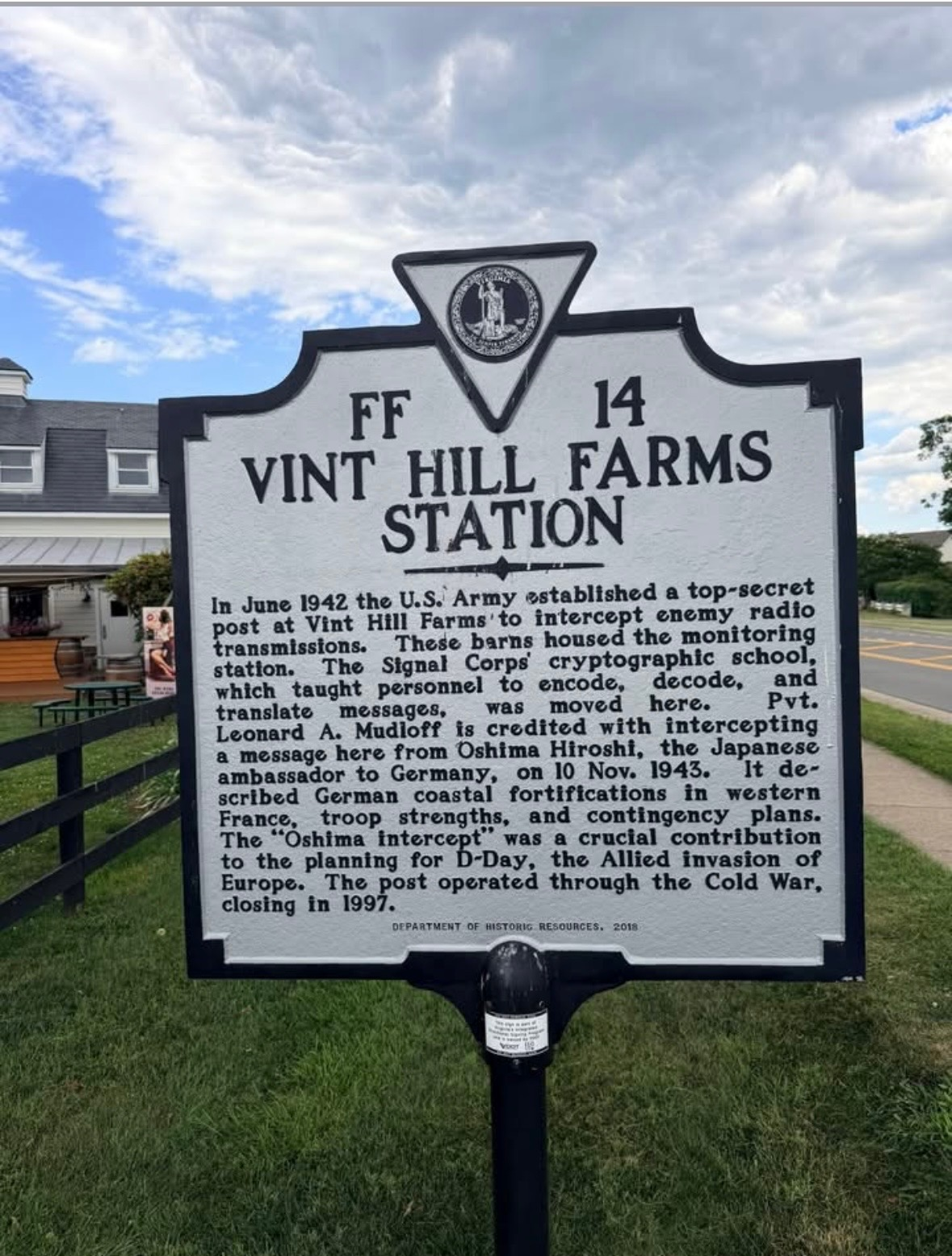
The furlough roster — “Procarione · 35892966 · Pvt,” Vint Hill Farms, January 1944.The site today: the Virginia state marker for Vint Hill Farms Station, the Army's top-secret WWII radio-intercept post and Signal Corps cryptographic school where James was stationed before shipping overseas.
Source: Morning Report — Det., 2nd Sig. Serv. Bn. (NARA Roll 460, Jan 1944); historical marker FF-14, Virginia Department of Historic Resources, 2018 (present-day photograph)
Context / in progress
c. January 16, 1944
Home on furlough — “Dinner Honors Soldier”
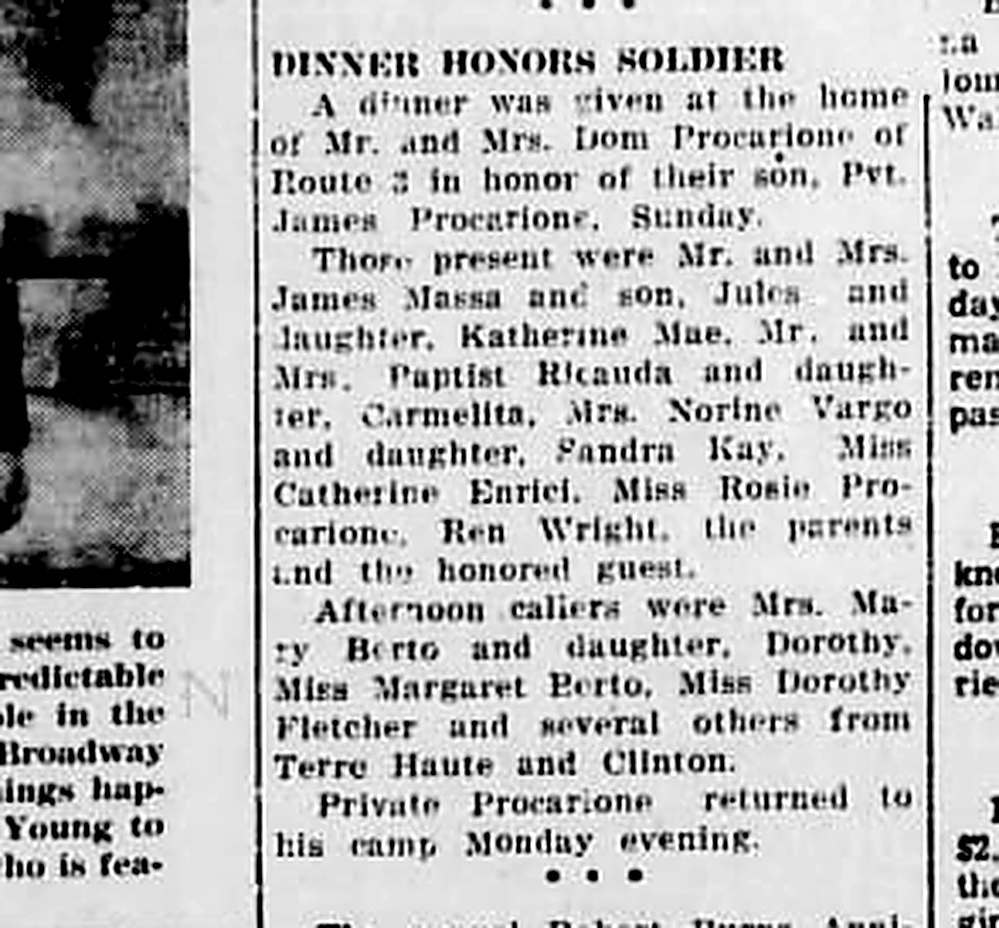
His hometown paper caught the human side of that Vint Hill furlough. The Daily Clintonian of January 21, 1944 ran a note headed “Dinner Honors Soldier”: a dinner was given at the home of Mr. and Mrs. Dom Procarione of Route 3 — James's parents, Domenic and Julia — “in honor of their son, Pvt. James Procarione,” on Sunday, with his sister Rosie [Rosemary] and a Vargo aunt among the guests. The item closes: “Private Procarione returned to his camp Monday evening.” It matches his Army record: the January 1944 Morning Report shows him granted a 10-day furlough from Vint Hill Farms Station, and this is that leave, spent at home in Clinton before he shipped for England. Newly discovered — the first newspaper account to name James personally.
“Dinner Honors Soldier” — The Daily Clintonian, Jan 21, 1944: a dinner for Pvt. James Procarione at his parents' home on Route 3; “Private Procarione returned to his camp Monday evening.”
Source: “Dinner Honors Soldier,” The Daily Clintonian (Clinton, Ind.), January 21, 1944, p. 5 (Newspapers.com); corroborates the Vint Hill furlough Morning Report (NARA Roll 460, Jan 1944)
Confirmed — Discharge
February 9, 1944
Sailed for Europe
Departed the United States for the European Theater of Operations during the pre–D-Day buildup.
Source: Honorable Discharge (WD AGO Form 53-55)
Confirmed — Army Morning Report
February 19, 1944
Lichfield, England — 10th Replacement Depot
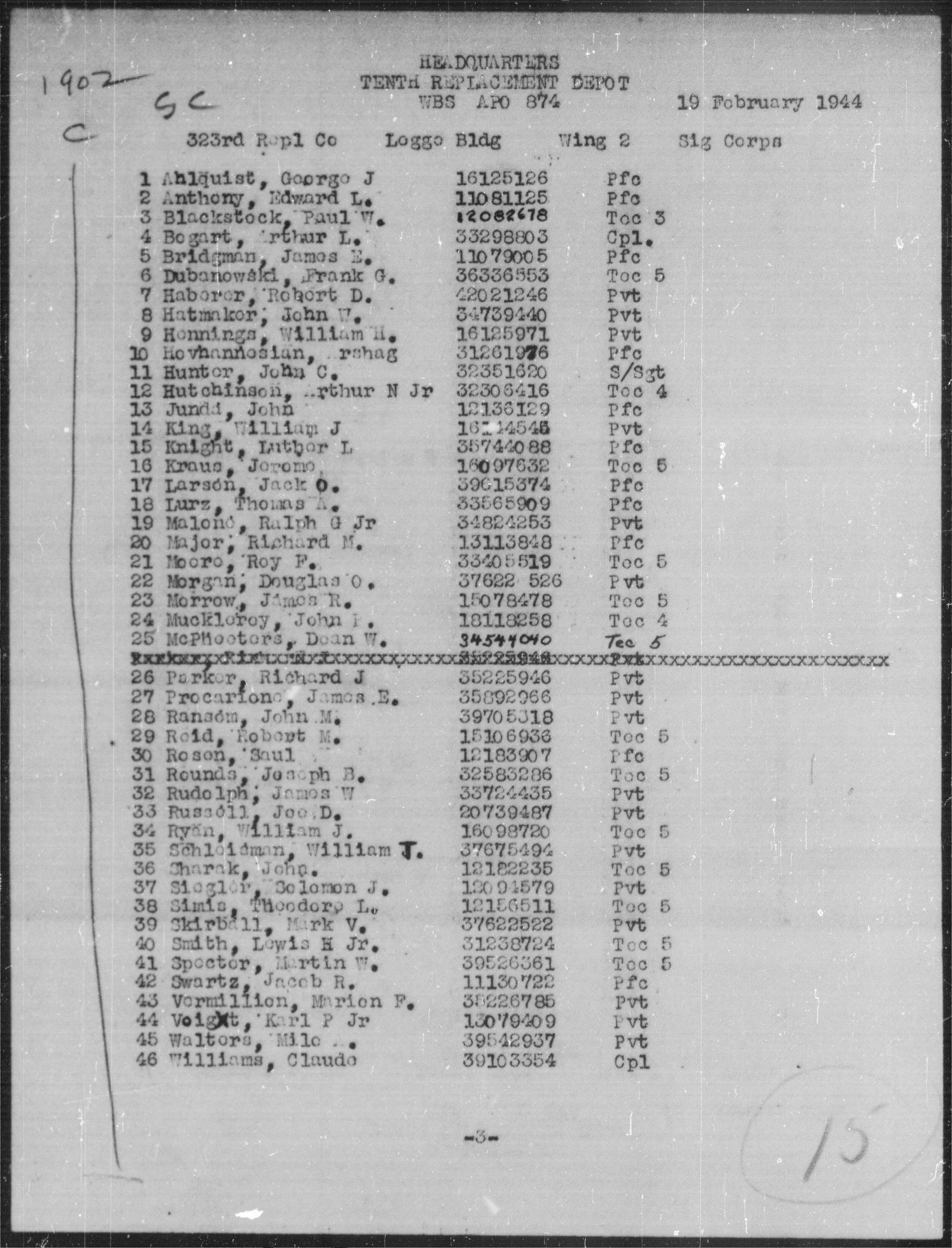
Ten days after sailing, he is in England, held and sorted as a Signal Corps replacement at the 10th Replacement Depot, 523rd Replacement Company, Lichfield, Staffordshire (APO 874). The same men who were beside him at Vint Hill appear beside him here — his group crossed the Atlantic together. Newly discovered.
The arrival roster — “27 Procarione, James E., 35892966, Pvt,” Lichfield, 19 Feb 1944.
Source: Morning Report — 10th Repl. Depot (NARA Roll 656, Feb 1944)
Confirmed — Army Morning Report
March 4, 1944
Lichfield — ordered out of the replacement depot
After two weeks in the replacement pool, an order sends him to a real unit. Special Orders No. 64, Headquarters 10th Replacement Depot relieves him from the Casual Detachment and directs the men named to “proceed to their proper stations and organizations, reporting upon arrival to the commanding officer thereat for duty.” His line carries the military-occupation code 521. The depot's daily reports also catch a small human detail the week before: on 5 March he is listed among a handful of men sick in quarters, and back on duty — a minor illness, a month before the hospital stay that follows. Newly discovered.
Source: Special Orders No. 64, Hq 10th Replacement Depot, WRS SOS ETOUSA, APO 874, 4 March 1944 (NARA Roll 624, image 760; also Rolls 657 and 750); Casual Detachment Morning Reports, 2 and 5 March 1944 (NARA Roll 624)
Confirmed — Army Morning Report
April 24, 1944
Near London, England — 118th Signal Radio Intelligence Company
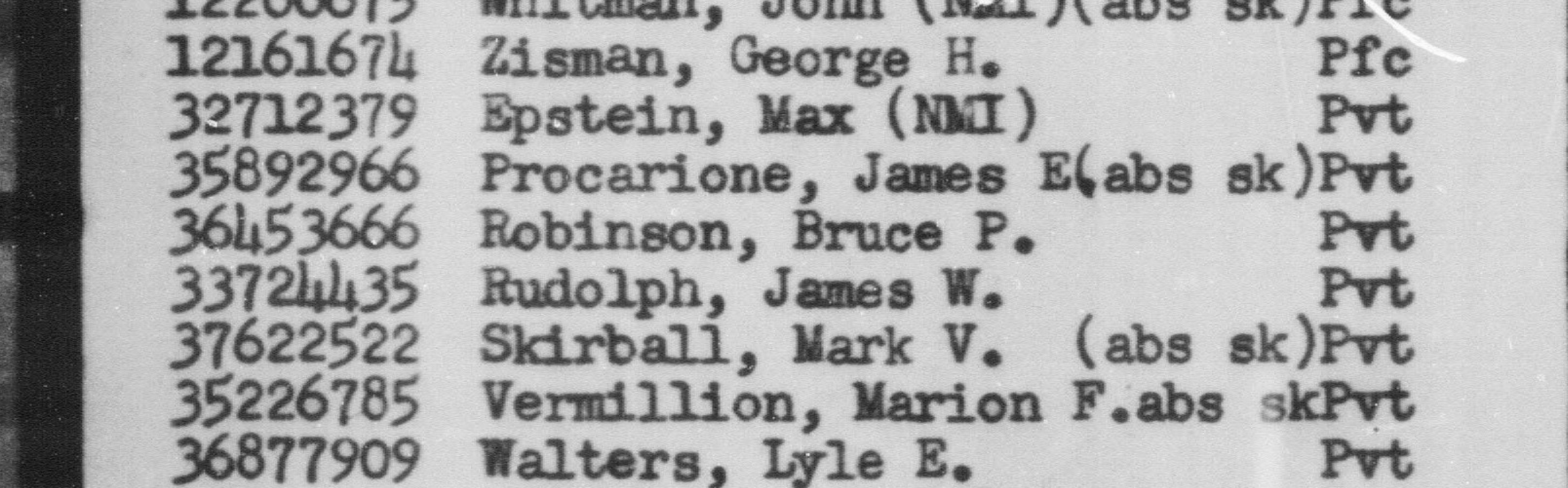
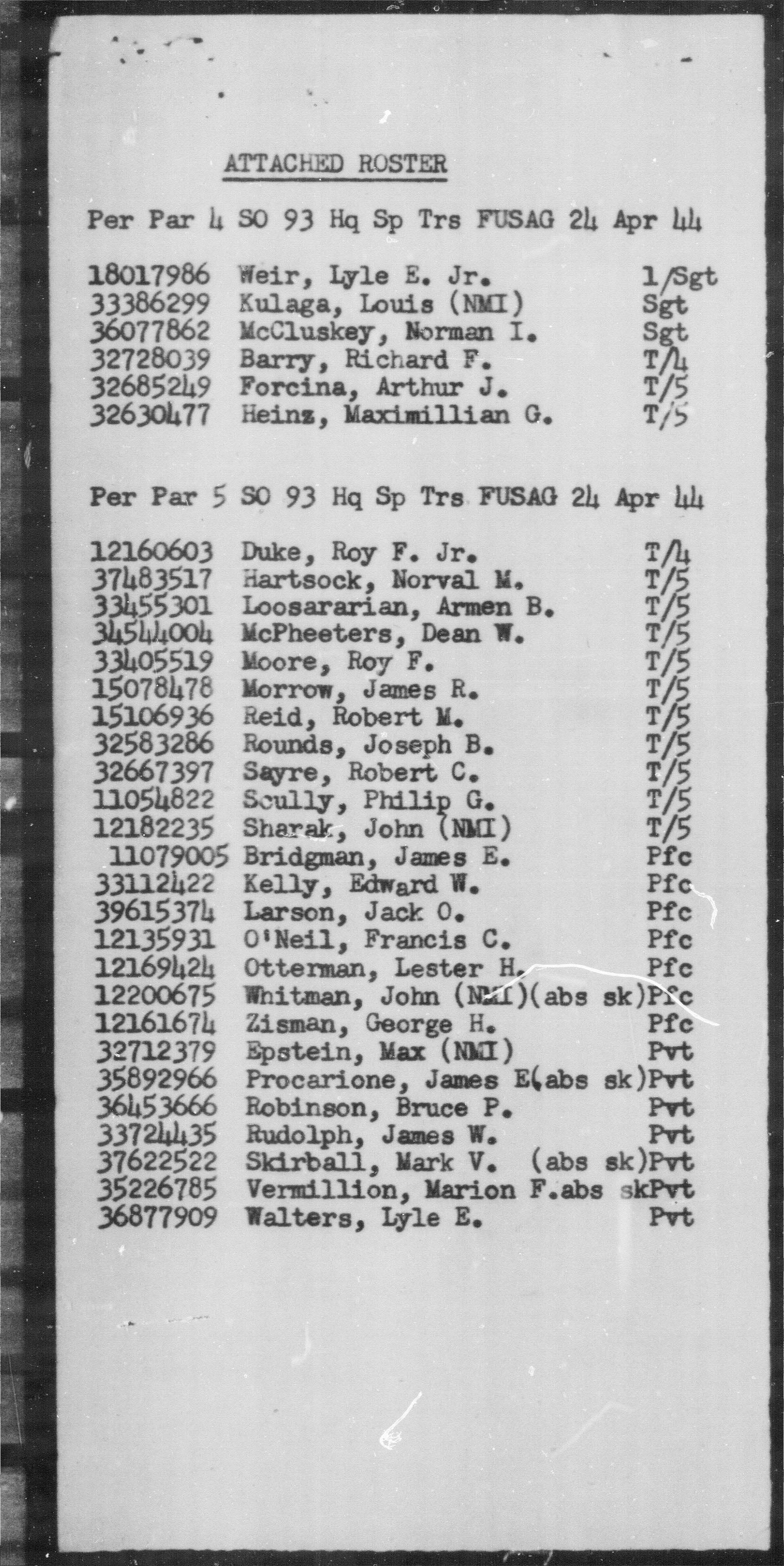
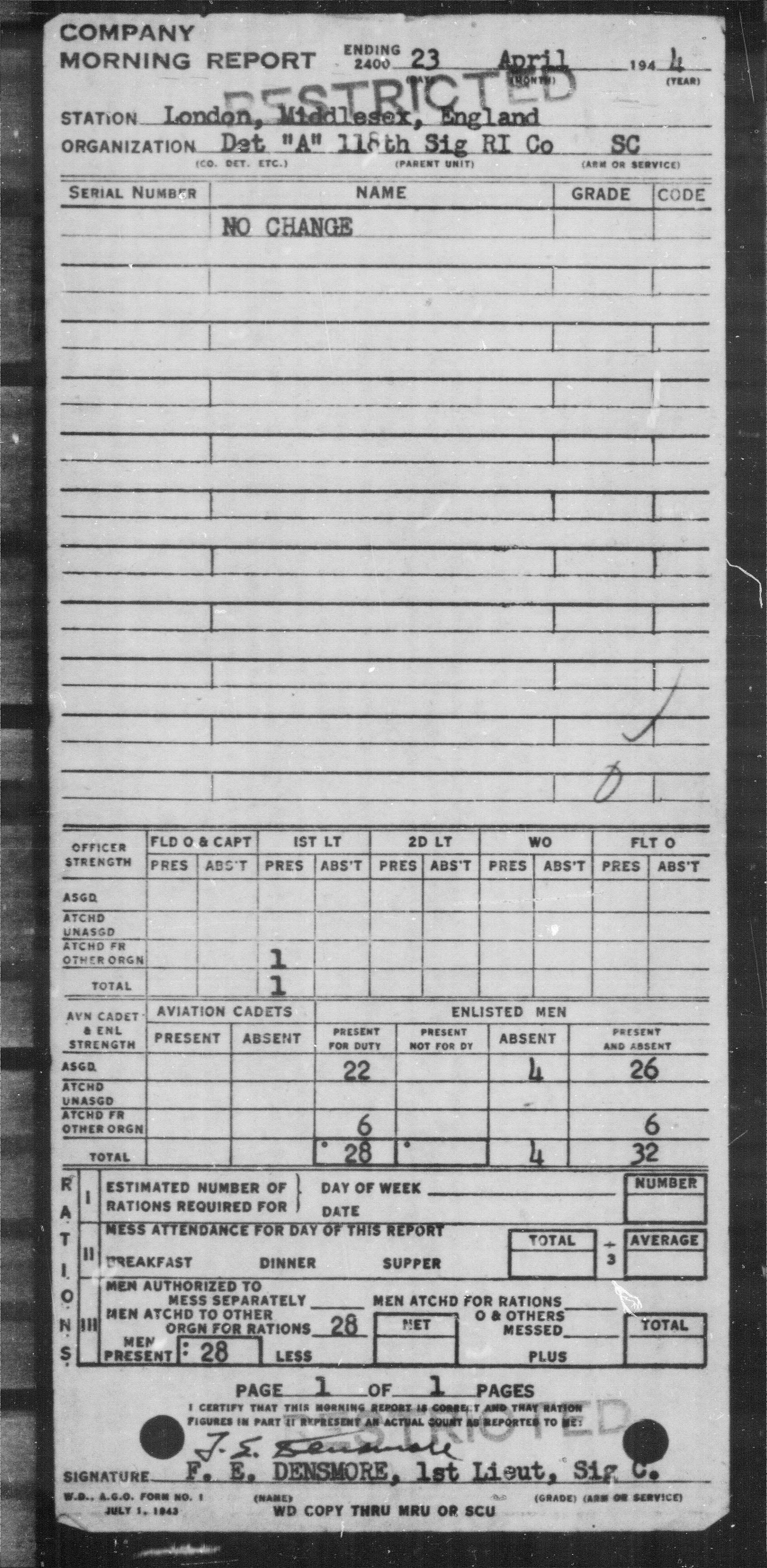
From the replacement depot he is transferred to the 118th Signal Radio Intelligence Company (APO 657, near London) — a Signal Corps signals-intelligence unit (radio intercept and direction-finding) — and billeted with the 203rd MP Company for rations and quarters. On this day's roster he is marked “absent sick.” His January/February travelling companions are right there with him (Larson, Rounds, Skirball, Vermillion, Robinson). A separate Army medical record now explains that “absent sick”: a WWII Hospital Admission Card for James (service number 35892966) records an April 1944 admission for acute arthritis, from which he was returned to duty — his first documented illness overseas, and one he recovered from without leaving the service. Newly discovered.
His entry, up close: “35892966 · Procarione, James E. (abs sk) · Pvt.” “Abs sk” means absent sick — and two friends listed right beside him, Skirball and Vermillion, were sick that day too.The full attached roster he appears on, near London, 24 April 1944.His unit's Morning Report (WD AGO Form 1): “Det ‘A’, 118th Sig R.I. Co., SC — Station: London, Middlesex, England — 23 April 1944,” signed Lt. F.E. Densmore.
Source: Morning Report — 118th Sig. R.I. Co. (Attached Roster, SO 93, Hq Special Troops, FUSAG; NARA Roll 596, Apr 1944); WWII Hospital Admission Card File, 1942–1954 (Office of the Surgeon General, RG 112; via Ancestry) — April 1944 admission, acute arthritis, returned to duty
Context / in progress
May 1944
His company, photographed at Dartford, Kent
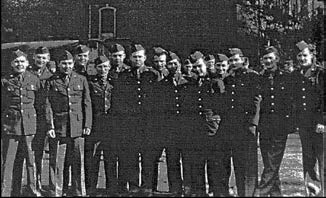
A published U.S. Army study of Patton's wartime intelligence reproduces a photograph of soldiers of the 118th Signal Radio Intelligence Company at Dartford, Kent, in May 1944 — the weeks James was carried on the company's rolls (he had joined it on 24 April). These are the men of his company: young, sharply dressed enlisted soldiers of one of the Army's hand-picked radio-intelligence outfits, drawn (the same study notes) from radio-trade schools and colleges and chosen for their technical skill and languages. The original caption names no individuals, so James cannot be picked out of the group with certainty — but this is his company, in the month and place his own records put him there. The photo traces to the published 118th company history (DeGrote), via the Marshall Foundation archives.
Soldiers of the 118th Signal Radio Intelligence Company — James's unit — at Dartford, Kent, May 1944.
Source: S. L. French, Not Just Lucky: How Patton's Third Army Adapted to Generate Information Advantage, 1944 (Art of War Papers, Army University Press, 2023), Fig. 4.1 — sourced to J. W. DeGrote, The 118th Signal Radio Intelligence Company, 1942–1946, Marshall Foundation Library & Archives
Confirmed — Army Morning Report
May 4–5, 1944
Out of hospital, back to duty
He comes back. The 203rd MP Company — the unit he was billeted with for rations and quarters — records him “from sick in 1st General Hospital, APO 617, to duty, 1400 hours,” and the hospital's own patient detachment releases him the same week. The illness that put him on the April roster as “absent sick” — acute arthritis, per his Army medical card — is over, and it kept him off duty for roughly a month. He rejoins his company with three weeks to spare before the order that changes his war. Newly discovered.
Source: Morning Report — 203 MP Co, London (NARA Roll 656, May 1944, image 673); Detachment of Patients, 1st General Hospital, Remarks for Morning Report of 5 May 1944 (NARA Roll 651, image 434)
Confirmed — Army Morning Report
May 25, 1944
“Alerted for departure”
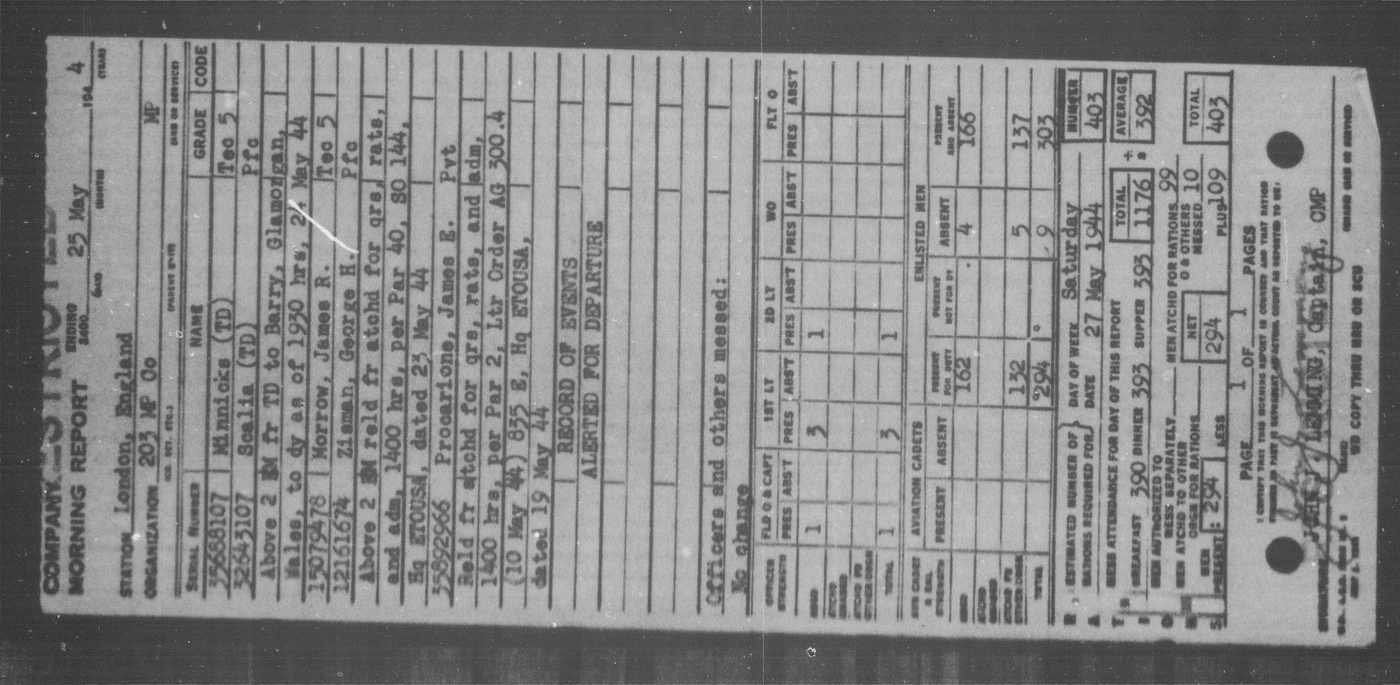
His company's Morning Report for this day, at London, releases him from attachment to the 203rd MP Company for quarters, rations and administration at 1400 hours — and in the box headed Record of Events, the clerk has typed three words: “ALERTED FOR DEPARTURE.” Something is about to happen to him. It happens the next day. Newly discovered.
203rd MP Co, London, 25 May 1944 — his line, and the Record of Events: “ALERTED FOR DEPARTURE.”
Source: Company Morning Report — 203 MP Co, London, ending 2400 hrs 25 May 1944, per Par 2, Ltr Order AG 300.4 (10 May 44) 835 E, Hq ETOUSA, dated 19 May 1944 (NARA Roll 656, image 696)
Confirmed — Army Morning Report
May 26, 1944
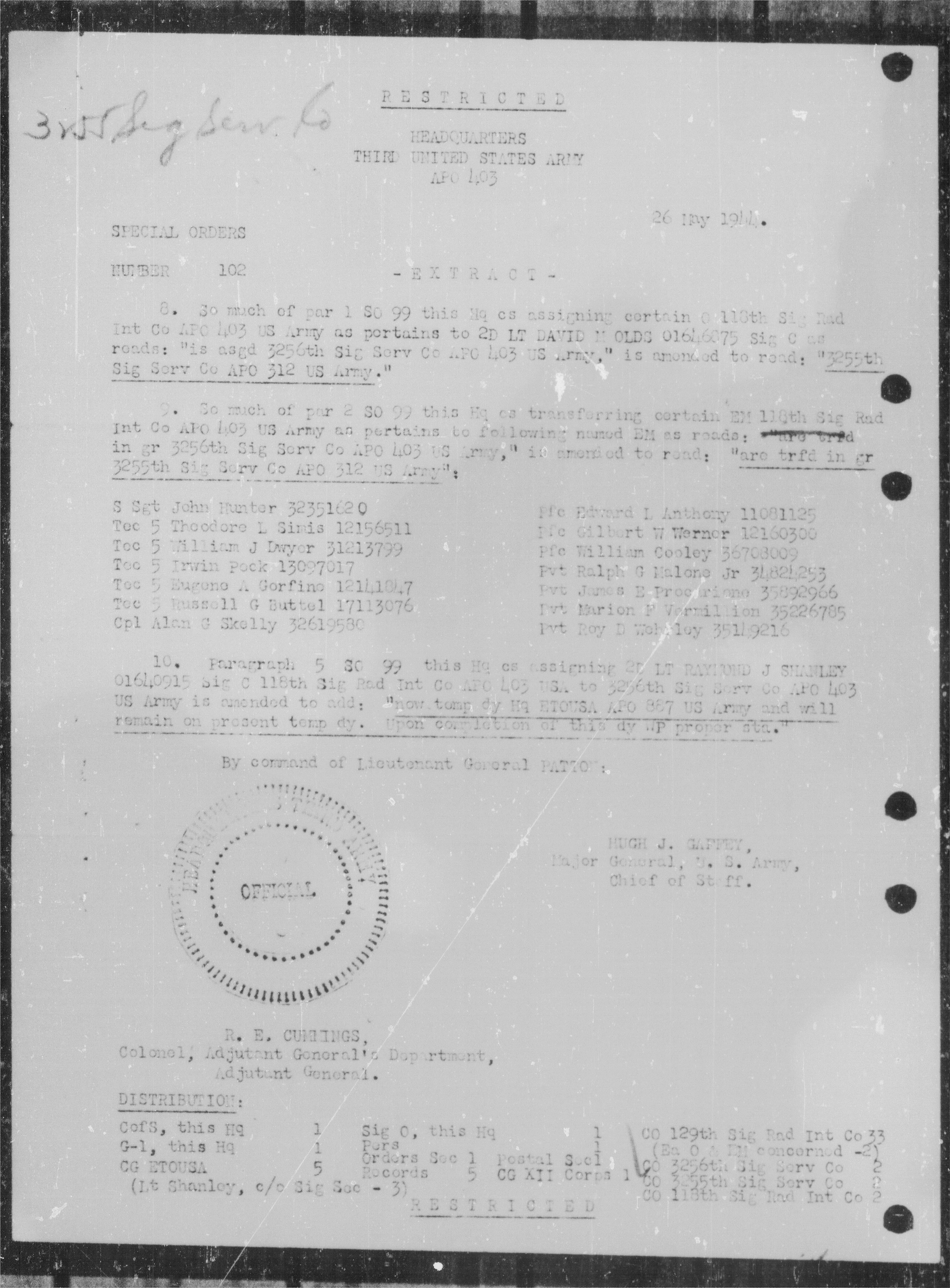
Patton's order — transferred to the 3255th Signal Service Company
This is the document the whole search was for. Special Orders No. 102, Headquarters, Third United States Army — marked RESTRICTED, issued “by command of Lieutenant General Patton” — transfers fourteen enlisted men of the 118th Signal Radio Intelligence Company“in grade to the 3255th Signal Service Company, APO 312.” Twelfth on the list: Pvt James E Procarione, 35892966. This is the day he joins the unit he would be discharged from twenty months later — and until now, nobody knew how or when he got there.
The order is a correction, which is why it stayed hidden so long. An earlier order (SO 99) had sent these men to the 3256th; this one changes the destination to the 3255th. Someone at Third Army headquarters even pencilled “3255 Sig Serv Co” in the margin of the page. One paragraph above James's name, the same order redirects 2d Lt David M Olds — the officer whose wartime memoir is one of the two best accounts we have of this company — to the 3255th as well. And heading the list of fourteen is S/Sgt John Hunter, whose 1945 letters home, preserved at San Diego State University, describe the very unit James was joining. James, the memoirist, and the letter-writer all moved on one piece of paper, on one day.Newly discovered.
Special Orders No. 102, Third U.S. Army, 26 May 1944: “are trfd in gr 3255th Sig Serv Co APO 312 US Army” — with “Pvt James E Procarione 35892966” twelfth of fourteen.
Source: Special Orders No. 102, Headquarters Third United States Army, APO 403, 26 May 1944 (Extract, RESTRICTED) — by command of Lieutenant General Patton; Maj. Gen. Hugh J. Gaffey, Chief of Staff. Filed in the Morning Reports at NARA Roll 736 (June 1944), image 904; re-filed Roll 519 (August 1944), image 1384
Context / in progress
May 27, 1944
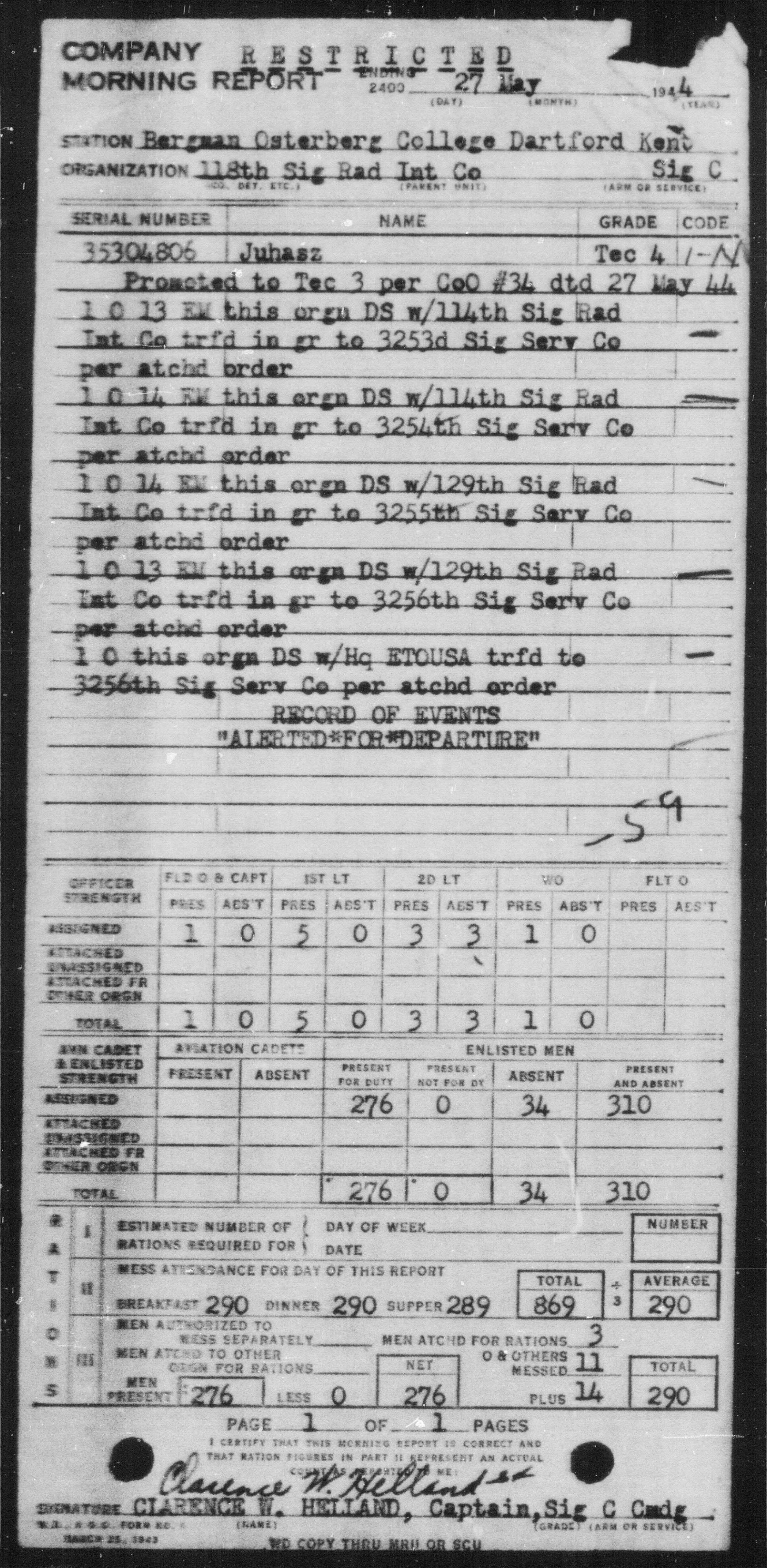
The 118th–3255th administrative link appears
A 118th Signal Radio Intelligence Company Morning Report shows groups being transferred in grade to numbered Signal Service Companies while remaining on detached service with Signal Radio Intelligence companies. One group — 1 officer and 14 enlisted men on detached service with the 129th Sig Rad Int Co — was transferred to the 3255th Signal Service Company. We now know exactly who those fifteen men were: this is the company's own record of Special Orders No. 102 from the day before — the officer is Lt David M Olds, and James is one of the fourteen enlisted men. His name is not printed on this page, but the transfer it counts is his.
118th Sig Rad Int Co report, 27 May 1944: groups transferred to the 3253d, 3254th, 3255th, and 3256th Signal Service Companies.
Source: Morning Report — 118th Sig. R.I. Co., Dartford, Kent (NARA Roll 493, May 1944)
Context / in progress
June 6, 1944
D-Day — where James was: still in England
On the morning of the Normandy landings, James was in southern England, part of the pre-invasion buildup waiting to follow the assault divisions across the Channel — not on the invasion beaches. The last record to name him personally, eleven days earlier, was Patton's Special Orders No. 102, transferring him from the 118th Signal Radio Intelligence Company into the 3255th Signal Service Company (26 May 1944). Neither of his units had crossed to France yet: the 118th was still reporting from Kent in late May and would not land at Utah Beach until 15 July 1944, and his eventual discharge unit, the 3255th Signal Service Company, was still assembling in England — its own Morning Reports place it at Wincham Hall, Cheshire, on 9–10 June, just three days after D-Day (next entry). No document names James individually on June 6, 1944; this entry is reconstructed from his last confirmed location and his units' whereabouts that week.
Source: Reconstructed — last personal record (SO No. 102, Hq Third U.S. Army, 26 May 1944, NARA Roll 736); 118th Sig. R.I. Co. location 27 May 1944 (NARA Roll 493) and Utah Beach landing 15 Jul 1944; 3255th Sig. Sv. Co. Morning Reports 9–10 Jun 1944 (NARA Roll 736)
Context / in progress
June 9–10, 1944
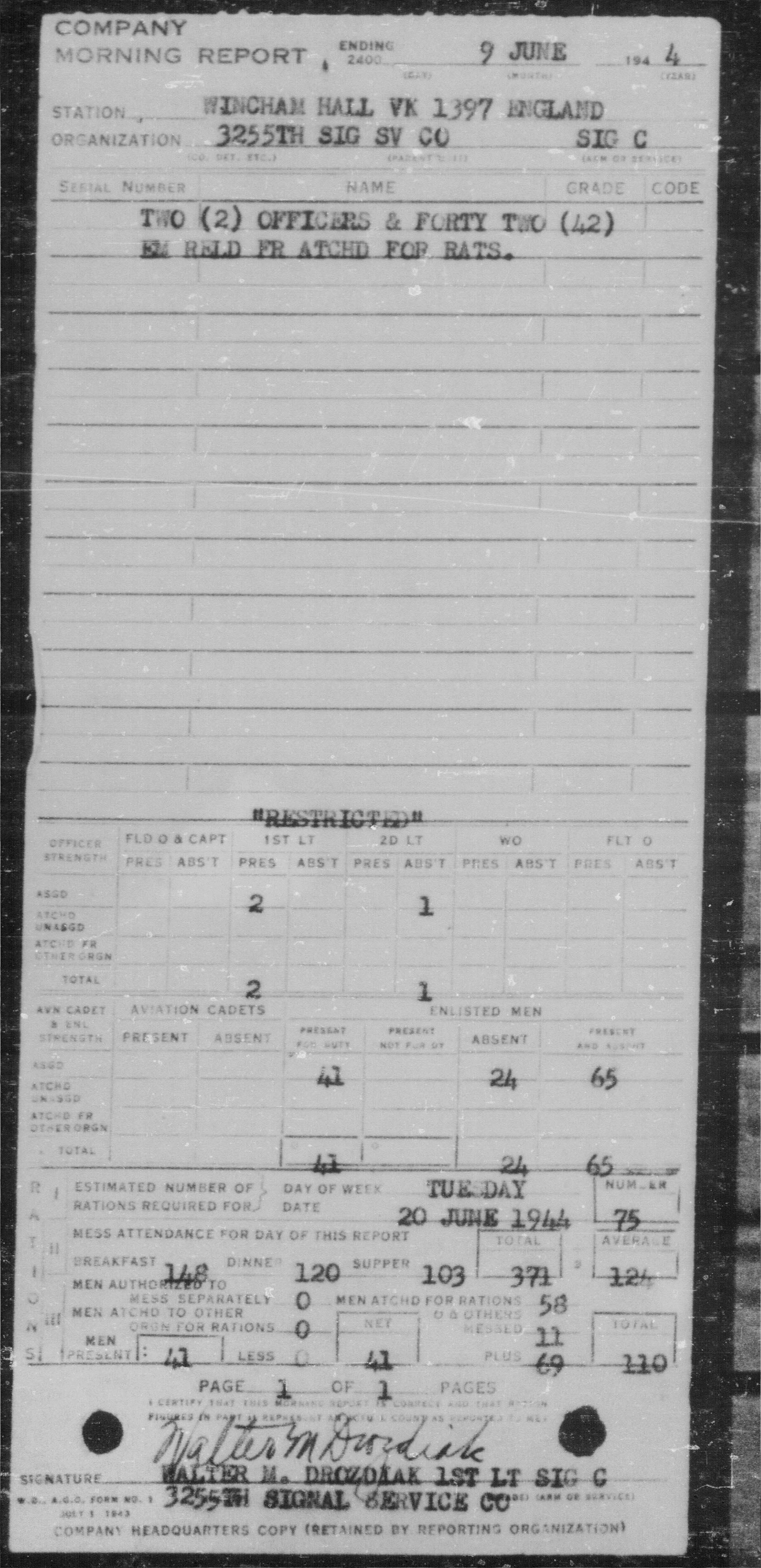
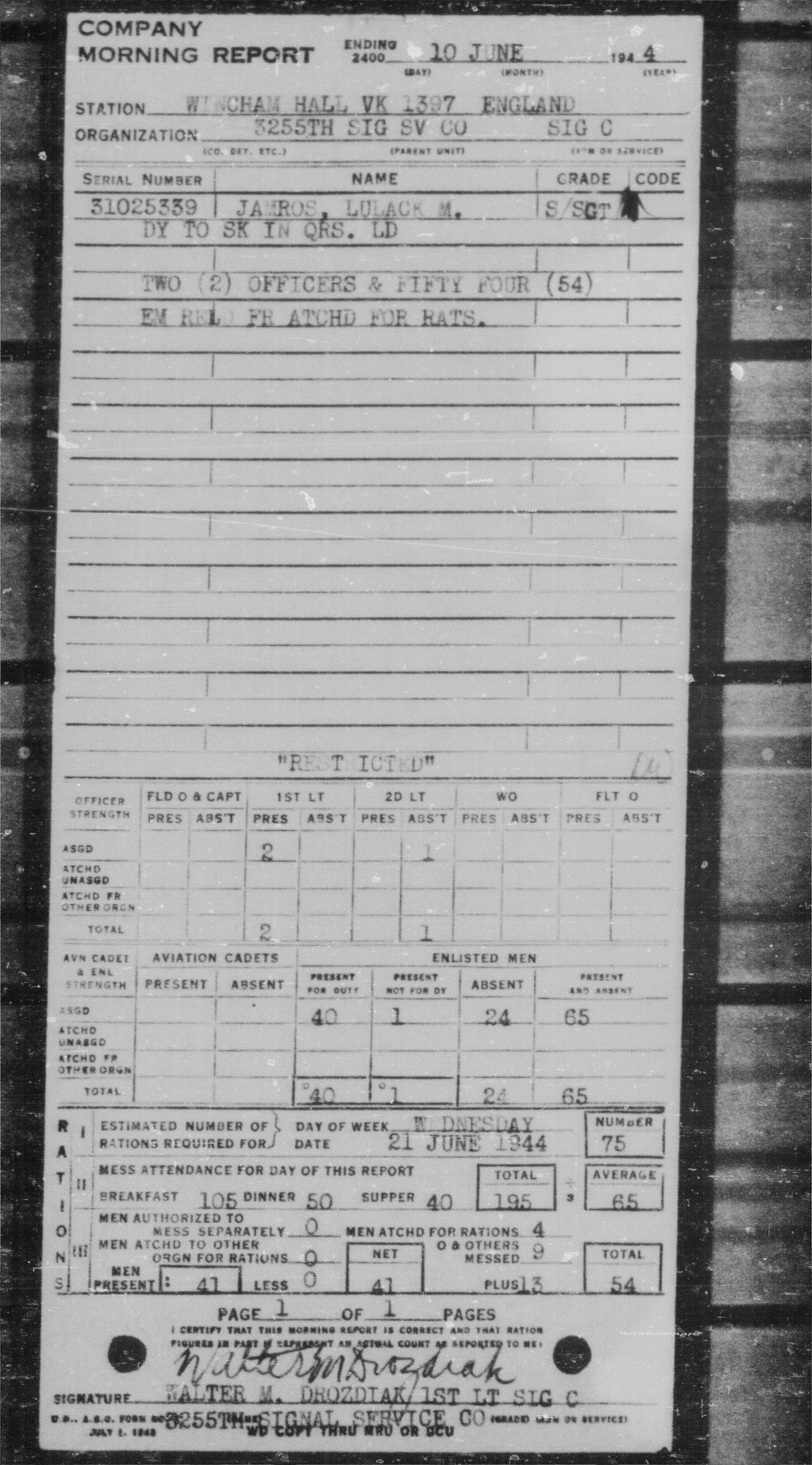
3255th Signal Service Company — Wincham Hall, Cheshire, England
The 3255th Sig Sv Co appears in its own Morning Reports at Wincham Hall, VK 1397, England — Wincham, a village in Cheshire next to the great U.S. Army camp at Marbury Hall, near Northwich. (The station line was long read as “Wingham Hall”; XII Corps' own SECRET station list of 7 June 1944 settles it, carrying the 3255th Sig Serv Co at “Marbury,” map coordinate VK 1397 — the same coordinate the Morning Report types out — among the units assigned to the corps while it staged in England.) The reports show a small company headquarters, with many personnel attached out or relieved from attachment for rations — matching the detached-duty pattern seen in the radio-intelligence companies. No James entry has been found on these pages.
3255th Signal Service Company, Wincham Hall (Cheshire), 9 June 1944.3255th Signal Service Company, Wincham Hall (Cheshire), 10 June 1944.
Source: Morning Reports — 3255th Sig Sv Co (NARA Roll 736, June 1944); Station List No. 7, HQ XII Corps (England), 7 June 1944 — reproduced in Lt Col George Dyer, XII Corps: Spearhead of Patton's Third Army, Appendix A (p. 509)
Context / in progress
July 9–10, 1944
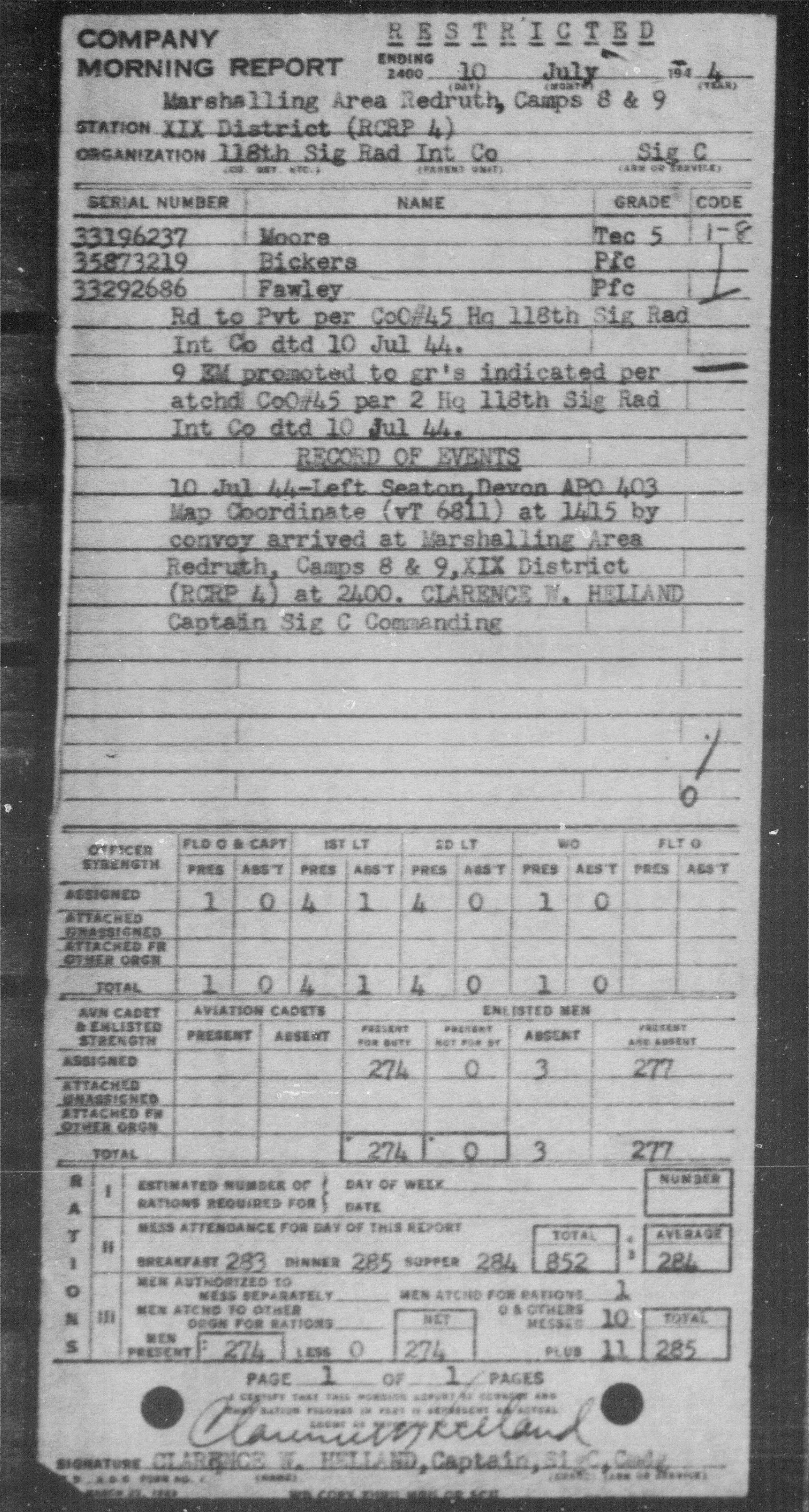
118th Sig Rad Int Co moves from Seaton to Redruth
A later 118th Morning Report shows the unit at Seaton, Devon, alerted for departure, then moving to Marshalling Area Redruth, Camps 8 & 9. This places the 118th in the staging pipeline for the move to the Continent. The company's own published history independently records the same departure — the 118th leaving Seaton, Devon on 10 July 1944 for a marshalling area near Penzance, bound for the Channel — matching James's Army records day for day. Exact service-number, cohort, and fuzzy-name searches of this July roll did not find James personally.
118th Sig Rad Int Co left Seaton, Devon and arrived at Marshalling Area Redruth at 2400, 10 July 1944.
Source: Morning Reports — 118th Sig Rad Int Co (NARA Roll 565, July 1944); corroborated by Stanley K. Scott & John De Grote, World War II: Perception to Reality (2018), the published 118th company history
Context / in progress
July 25–26, 1944
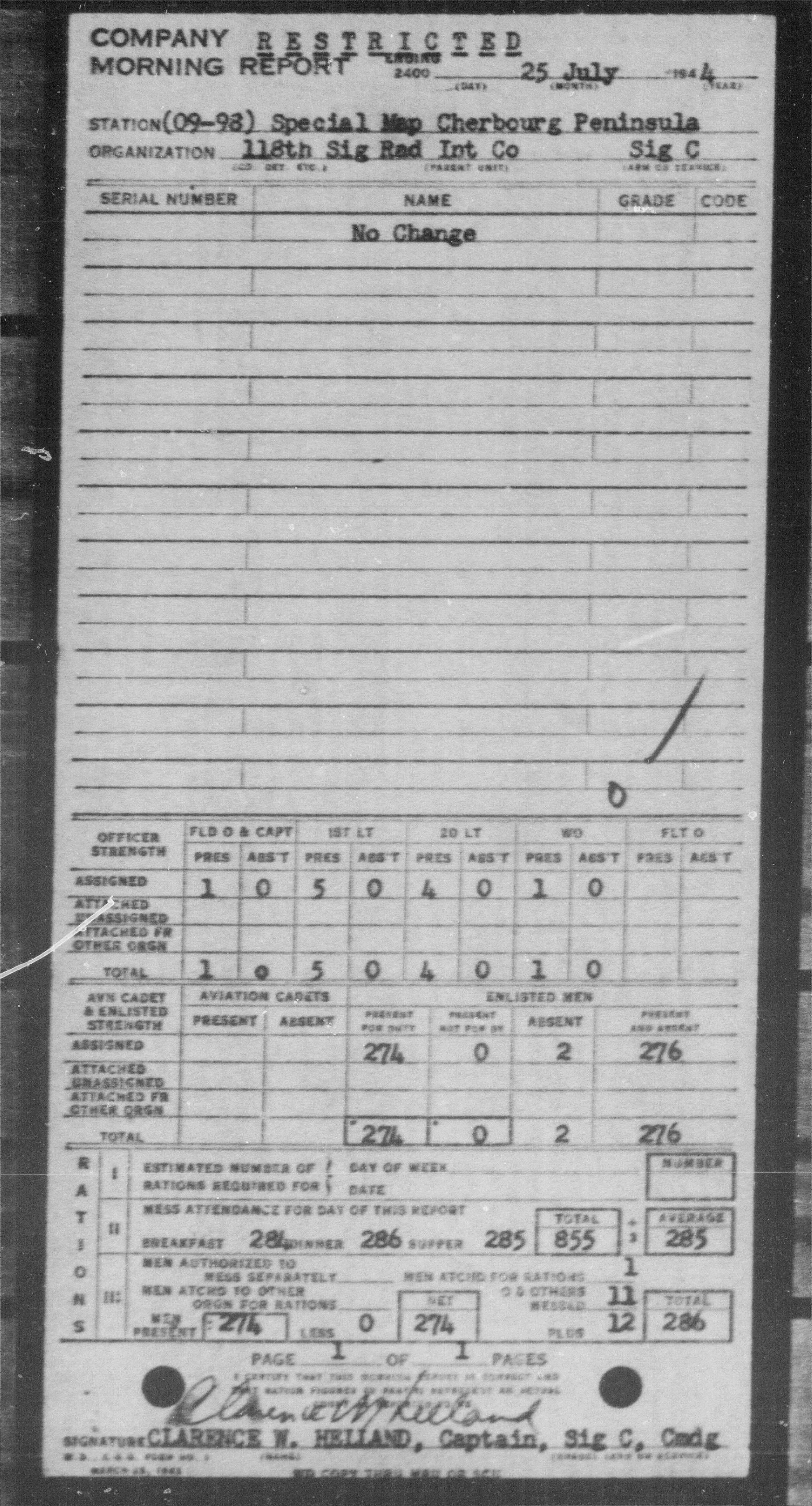
118th Sig Rad Int Co — Cherbourg Peninsula
By late July, the 118th Sig Rad Int Co is reporting from a Special Map Cherbourg Peninsula station. This is unit-movement context only, but it shows the radio-intelligence unit had crossed from England to France by this point.
118th Sig Rad Int Co report from Special Map Cherbourg Peninsula, 25 July 1944.
Source: Morning Reports — 118th Sig Rad Int Co (NARA Roll 565, July 1944)
Context / in progress
Late July 1944
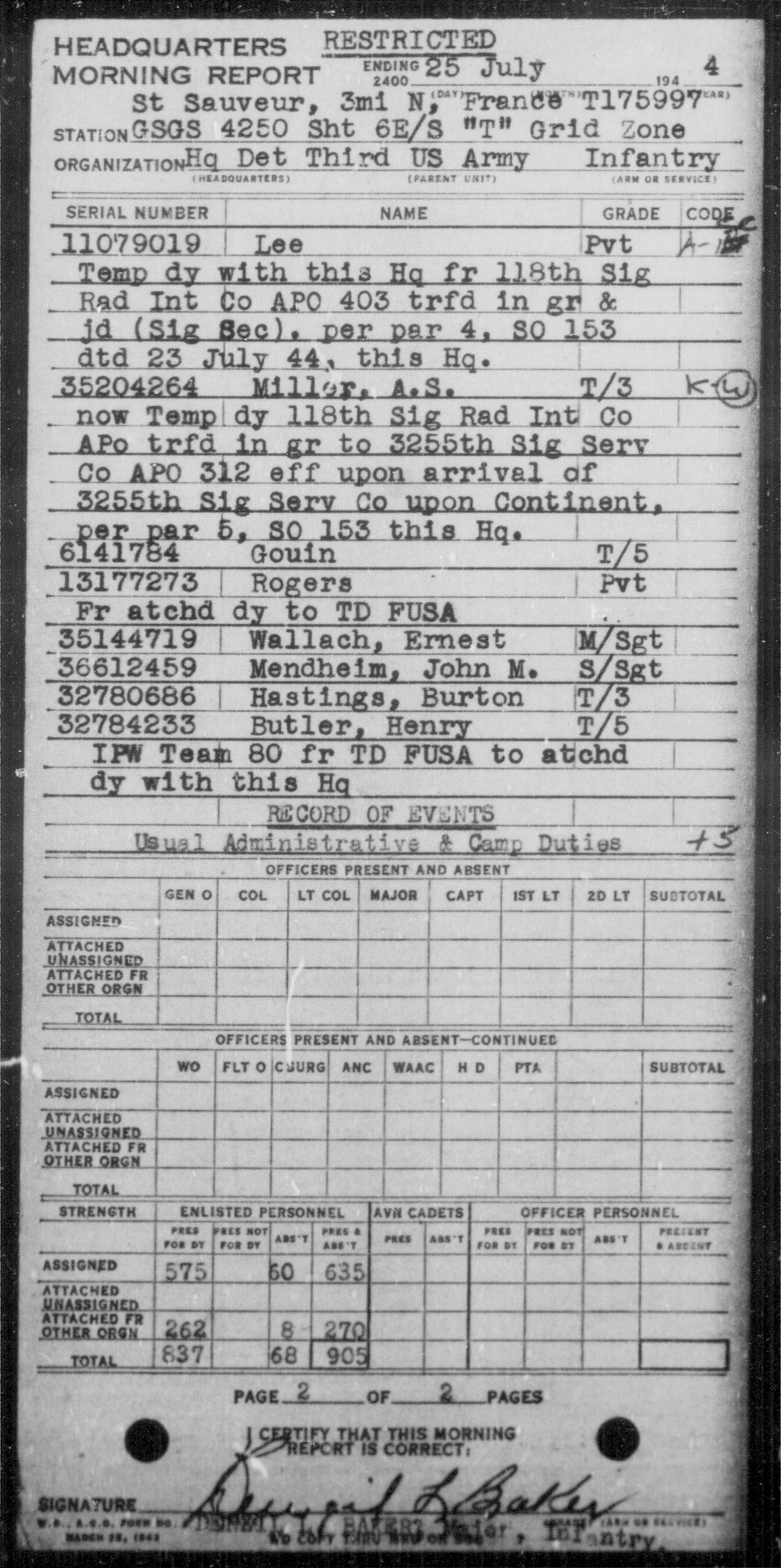
His unit reaches France — the 3255th crosses to the Continent (Third Army)
A Headquarters Detachment, Third U.S. Army Morning Report, filed from St-Sauveur-le-Vicomte in Normandy, France, records men transferred in grade from the 118th Signal Radio Intelligence Company to the 3255th Signal Service Company, “effective upon arrival of the 3255th Signal Service Company upon the Continent.” This is the first record to tie both of James's units directly to General Patton's Third U.S. Army, and it shows the 3255th — his discharge unit — crossing into France around late July 1944, by the same transfer mechanism that had moved James out of the 118th. James is not named on this page, but it documents his unit's path onto the Continent.
Hq Det, Third U.S. Army, at St-Sauveur, France: 118th Sig R.I. Co. men transferred to the 3255th Sig Serv Co “upon arrival … upon the Continent,” late July 1944.
Source: Morning Report — Hq Det, Third U.S. Army, St-Sauveur-le-Vicomte, France (Par 5, SO 153; NARA Roll 775, July 1944)
Context / in progress
August 1944 – May 1945
On XII Corps' secret station lists — code name “Habitant”
The complete edition of XII Corps' official history reproduces the corps' wartime SECRET G-3 station lists in its appendices — and James's company is on every one of them, from England to V-E Day, under its radio code name “Habitant.” On the first continental list (18 August 1944) the corps' own clerks write the unit as “3255 Sig Serv Co RI” — Radio Intelligence — in a contemporary operational document. Read together, the lists are a dated, town-by-town skeleton of the company's road across Europe: 5 km south of Cloyes-sur-le-Loir in the race across France (18 Aug 44) → 2 km north of Sompuis, Marne (1 Sep 44) → Nancy (14 Oct 44) → Saaralben [Sarralbe], Lorraine (12 Dec 44) → Luxembourg City in the Bulge (24 Dec 44) → Bad Kreuznach at the Rhine (23 Mar 45) → 2 km west of Bayreuth (22 Apr 45) → Grafenau, Bavaria, on the V-E Day list (9 May 45). Since James joined the 3255th on the Continent around late July 1944, these fixes trace his road through the campaign year his burned personnel file can no longer tell. Station lists place the company, not the individual soldier; detached intercept and direction-finding teams often worked miles from the company area.
Source: HQ XII Corps G-3 station lists (SECRET), Nos. 1–85, 18 Aug 1944 – 9 May 1945, reproduced in Lt Col George Dyer, XII Corps: Spearhead of Patton's Third Army (XII Corps History Association, 1947), Appendix A, Part II (pp. 509–524; complete CARL digital-library edition, verified against the page scans)
Context / in progress
Later in 1944 – 1945
3255th Signal Service Company — his final unit was a radio-intelligence team
James's discharge names the 3255th Signal Service Company as his final unit. Public Army records now show what that unit was: a small corps-level radio-intelligence (signals-intelligence) company, not a general communications outfit — one of a series (the 3253rd, 3254th, 3255th and 3256th) created in England in spring 1944 from the men of radio intelligence companies like the 118th. The 3255th's lineage was later carried forward into today's 305th Military Intelligence Battalion, and that successor unit's official campaign honors — Northern France, Rhineland, Ardennes-Alsace, and Central Europe — are the same four campaigns stamped on James's discharge. A fellow T-5, Carl K. Nall, later remembered the officer at Le Mans telling the men they were the “3255 Signal Service Company, attached to XII Corps”, and describing their secret work as control-hut and direction-finding duty. James's MOS was light truck driver (345): he drove and supported that radio-intelligence team. Nall does not name James personally; this is same-company, same-command evidence. The exact order or roster that moved James personally from the 118th into the 3255th is still the key missing document.
Source: Honorable Discharge (final unit); U.S. Army Center of Military History, Signals Intelligence in World War II (CMH Pub 70-43) and the “Intelligence in the Field” lineage series; 305th Military Intelligence Battalion lineage & honors; 118th Sig. R.I. Co. Morning Report, 27 May 1944 (NARA Roll 493); Carl K. Nall LOC VHP oral-history interview/transcript, 00:35:15–00:42:37
Confirmed — Campaign credit
August – mid-September 1944
Northern France — the breakout and race across France
James earned battle-star credit for the Northern France campaign. The geography below traces the advance of Patton's Third Army — and specifically XII Corps, the corps his radio-intelligence unit served (its assignment to XII Corps is named in the corps' own official history; see Central Europe, below): operational in France from 1 August 1944, driving east from Le Mans to liberate Orléans and Châteaudun, then taking Sens, Troyes and Châlons, and seizing a Meuse River bridgehead at Commercy on 31 August before a fuel shortage briefly halted the pursuit. James's own company crossed in the middle of this drive: the published U.S. cryptologic history records the 3255th Signal Service Company — under the code-name “Sombrero” — reaching Normandy on 12 August 1944 and going into bivouac four miles east of Le Mans on 15 August, where it “got in touch with the 118th” before galloping east toward the Meuse and Moselle in Lorraine. Nall's interview fills in the soldier's-eye version of that movement: he said the unit landed at Utah Beach at 2200 hours on 12 August, moved past Saint-Lô, covered about 67 miles the first day, and at Le Mans was told it would be operational the next day as the 3255 Signal Service Company attached to XII Corps. (The 3255th had been built that spring from men of the 118th and 121st Radio Intelligence Companies; its commander, Capt. Walter M. Drozdiak, came from the 121st.) The corps' official history confirms Nall's memory from the other side of the hill: its order of battle for the Le Mans concentration of 13 August 1944 lists “3255th Sig Serv Co, 1st Lt W M Drozdiak, commanding,” and the corps' SECRET station lists then fix the company at 5 km south of Cloyes-sur-le-Loir on 18 August and 2 km north of Sompuis (Marne) by 1 September — dated map positions in the middle of the race across France. These are the movements of his unit and its parent corps, used to picture where his SIGINT team worked — not his individually recorded positions.
Source: Campaign credit — EAME ribbon (Discharge); XII Corps / Third Army route — Wikipedia “XII Corps (United States)” and “XII Corps: Spearhead of Patton's Third Army” (90thdivisionassoc.org); campaign dates — U.S. Army CMH campaign streamers; American Signal Intelligence in Northwest Africa and Western Europe (U.S. Cryptologic History, NSA), pp. 129–133 (the 3255th “Sombrero”); SRH-042, Third Army Radio Intelligence History (HQ Third U.S. Army); Dyer, XII Corps, ch. 8 (p. 156) and Appendix A station lists (pp. 512, 515); Carl K. Nall LOC VHP oral-history interview/transcript, 00:29:07–00:35:18 and 01:26:36–01:27:02
Confirmed — Campaign credit
Mid-September – November 1944
Rhineland — Lorraine and the fight for the Saar
His Rhineland campaign credit (the campaign ran 15 Sept 1944 – 21 March 1945) covers the grinding Lorraine fighting: an assault across the Moselle, the liberation of Nancy (15–16 Sept), the tank battle of Arracourt (19–20 Sept), and the November drive toward the Saar (Château-Salins, Faulquemont). Nall remembered the 3255th pulling into Nancy, France, at the end of September and staying around Nancy before the later Lorraine operations — and XII Corps' own station list of 14 October 1944 confirms him, carrying the 3255th at Nancy (code name Habitant, Capt. Drozdiak commanding). A signals-intelligence unit was vital here, locating German units by their radio traffic. His company's own November 1944 report places it operating around Armaucourt and Gremecey, just northeast of Nancy — running its wire lines into XII Corps (see “His Company's Own War Diary,” below).
Source: Campaign credit — EAME ribbon (Discharge); XII Corps route (Wikipedia / 90thdivisionassoc.org); CMH campaign dates; SRH-042, 3255th Sig. Serv. Co. Unit Operational History, Nov 1944; Dyer, XII Corps, Appendix A, Station List No. 37, 14 Oct 1944 (p. 516); Carl K. Nall LOC VHP oral-history interview/transcript, 00:45:25–00:46:00
Confirmed — Campaign credit
December 1944 – January 1945
Ardennes — the Battle of the Bulge
Battle-star credit for the Ardennes-Alsace campaign — the Battle of the Bulge, the largest battle the U.S. Army fought in WWII. When the German offensive struck on 16 December 1944, Patton wheeled the Third Army north; XII Corps shifted to the Luxembourg City area (21 Dec) and spent January clearing the west bank of the Moselle and assaulting across the Sauer. A lieutenant of James's own company, David Olds, remembered pulling into Kirchberg, on the edge of Luxembourg City, on a snowy 23 December 1944 — billeting the men in the village school, Christmas Eve services in the local church, and intercept and direction-finding teams pushed up toward the front. The company's own December 1944 report confirms it — covering operations near Morhange and Sarralbe, France, and Kirchberg, Luxembourg — an independent record matching Olds's memory. The corps' own paperwork now adds a third, dated layer: its station list of 12 December has the 3255th at Saaralben (Sarralbe), four days before the German offensive broke; a reproduced corps command-post close-in defense directive of 19 December lists the “3255 Sig Serv Co” among the units bivouacked at — and defending — the corps CP as the crisis opened; and the station list of 24 December shows the company arrived at Luxembourg City, one day after Olds's snowy Kirchberg memory. (See “A Comrade's Account” and “His Company's Own War Diary,” below.)
Source: Campaign credit — EAME ribbon (Discharge); XII Corps route (Wikipedia / 90thdivisionassoc.org); CMH campaign dates; SRH-042, 3255th Sig. Serv. Co. Unit Operational History, Dec 1944 (signed Capt. W. M. Drozdiak); Dyer, XII Corps, Appendix A, Station Lists Nos. 49 & 51 (pp. 517, 519) and the 19 Dec 1944 CP-defense directive from the HQ Commandant's file (p. 280)
Confirmed — Campaign credit
February – 21 March 1945
Rhineland — through the Siegfried Line to the Rhine
The Rhineland campaign continued: breaching the Siegfried Line bunkers along the Our and Sauer (February), driving to the Prüm, and reaching the Rhine in early-mid March (Andernach; then Bad Kreuznach and Worms by 21 March). The 3255th's February 1945 report places the company at Waldbillig, Luxembourg, with XII Corps headquarters just up the road at Fels.
Source: Campaign credit — EAME ribbon (Discharge); XII Corps route (Wikipedia / 90thdivisionassoc.org); CMH campaign dates; SRH-042, 3255th Sig. Serv. Co. Unit Operational History, Feb 1945
Confirmed — Campaign credit
22 March – 8 May 1945
Central Europe — across the Rhine to V-E Day
Battle-star credit for the Central Europe campaign. XII Corps made a hasty crossing of the Rhine at Oppenheim on 22–23 March 1945, then crossed the Main at Frankfurt and Hanau, uncovered the Nazi gold and looted-art hoard at the Merkers salt mine (4 April), drove through Bayreuth (21 April) and Grafenwöhr, helped liberate the Flossenbürg concentration camp (30 April), reached the Danube and pushed into Austria — taking Linz (5 May) and meeting the Red Army on V-E Day, 8–9 May 1945, with the corps command post at Grafenau, Bavaria. XII Corps' own official history puts James's unit on this road by name, listing “the 93rd Signal Battalion and the 3255th Signal Service Company” as the teams that kept the corps headquarters' message and signal centers running through this entire drive — and its station lists pin the company down date by date: at Bad Kreuznach on 23 March (the day the corps consolidated its Rhine-crossing headquarters there), 2 km west of Bayreuth on 22 April, and at Grafenau on the corps' V-E Day station list of 9 May, sharing the corps headquarters' own map coordinate. That last entry likely completes the picture in the family photograph below: Grafenau's outlying hamlet is named Neudorf — the village where Nall's map and the company's memory put the V-E Day news. As the company's light truck driver, James hauled that signal equipment and those men town by town along this route. The 3255th's own April and May 1945 reports track it deeper into Germany — on 21 April 1945 moving up to support the 90th Infantry Division at Langenzenn, near Nuremberg, and following the German panzer divisions toward the Czechoslovak border to the end of the war. Nall's interview adds late-war color from the same company: Lt. Bateman appears in his memory, he places the unit at Rosenheim, and he later shows a route map running through Frankfurt to Neudorf, where the men received V-E Day news. James received no wounds in action. Newly confirmed.
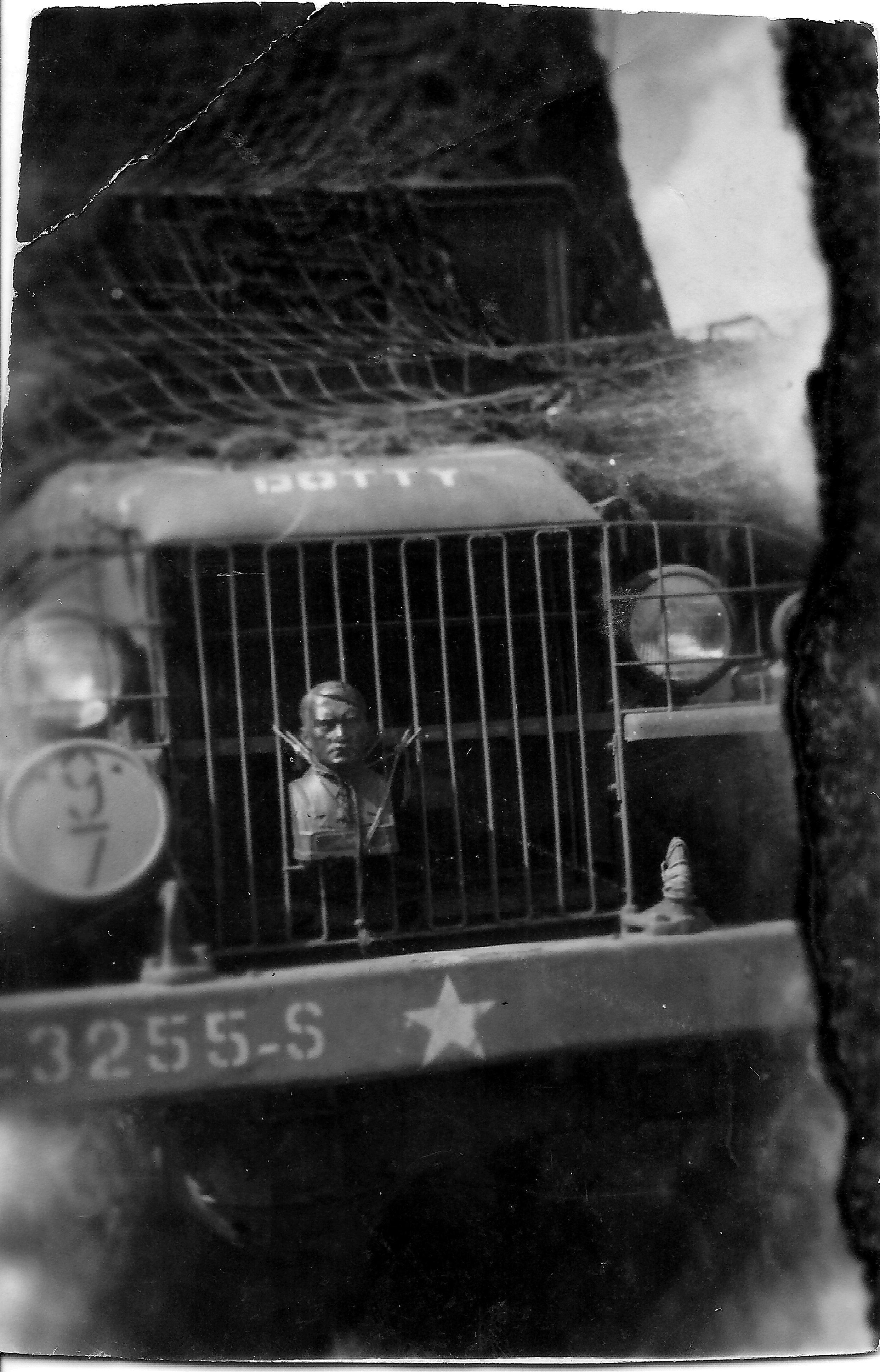
A family-held print: a Dodge WC-series signal truck named “Dotty” — bumper marking “3255-S” (3255th Signal), with the national star — at Neudorf, Germany, where the company received the V-E Day news. The yellow disc by the headlight is an Allied bridge-weight plate; its two numbers mean the truck was rated to tow a trailer — almost certainly a PE-95 generator trailer, the mobile power for the unit's radio-intercept stations. This is the light-truck-driver’s job in one photograph. A soldier stands framed in the brush guard; a “liberated” statue is wedged in as a mascot.
Source: Campaign credit — EAME ribbon (Discharge); XII Corps: Spearhead of Patton's Third Army (Lt Col George Dyer), pp. 38, 48, 86, 95, 103, 125 (90thdivisionassoc.org) — names the 3255th Signal Service Company; Dyer, Appendix A, Station Lists Nos. 69, 79 & 85 (pp. 521, 522, 524 — Bad Kreuznach, Bayreuth, Grafenau); CMH campaign dates; SRH-042, 3255th Sig. Serv. Co. Unit Operational History, Apr–May 1945; NSA, American Signal Intelligence in Northwest Africa and Western Europe; Carl K. Nall LOC VHP oral-history interview/transcript, 01:02:43–01:08:03 and 01:27:31–01:28:09; family-held photograph (original print)
Context / in progress
May 16, 1945
Detached from XII Corps — the corps' own record closes the assignment
A week after V-E Day, the working partnership ended. XII Corps' official history carries an appendix of every unit that served with the corps, with dates of attachment and detachment — and its Signal section reads: “3255 Sig Serv Co — 6 Sep 44 – 16 May 45.” The 16 May 1945 detachment is the first documented date for the end of the corps assignment, and it fits the other records: the company stood on the corps' V-E Day station list at Grafenau (9 May), left the corps on 16 May, and an NSA history records its war “ended” at Rosenheim on 22 May 1945 — the occupation-duty town where his comrades' letters and the published 118th history also place it. The 3255th then served on in Bavaria until its inactivation that October; James, a low-point man, stayed with it nearly to the end. His discharge records why: on the Army's 2 September 1945 demobilization count his Adjusted Service Rating stood at just 68 points — well below the 85 a soldier needed to be sent home early — so while high-point men shipped out that summer, James remained with his company through the occupation and did not start for home until December. The formal attachment date of 6 Sep 1944 is the paperwork catching up: the narrative and station lists show the unit working with XII Corps from May–August 1944 onward.
Source: Lt Col George Dyer, XII Corps: Spearhead of Patton's Third Army, Appendix B, Part I — units with dates of attachment and detachment (p. 535, Signal section; verified against the page scan); NSA Cryptologic Quarterly traffic-analysis history, Appendix (Rosenheim, 22 May 1945); Adjusted Service Rating score from the Honorable Discharge (WD AGO Form 53-55), Remarks (“ASR Score, 2 September 1945: 68”)
Context / in progress
July 17, 1945
After V-E Day — his company's commander is decorated, and the 3255th is named in Third Army orders
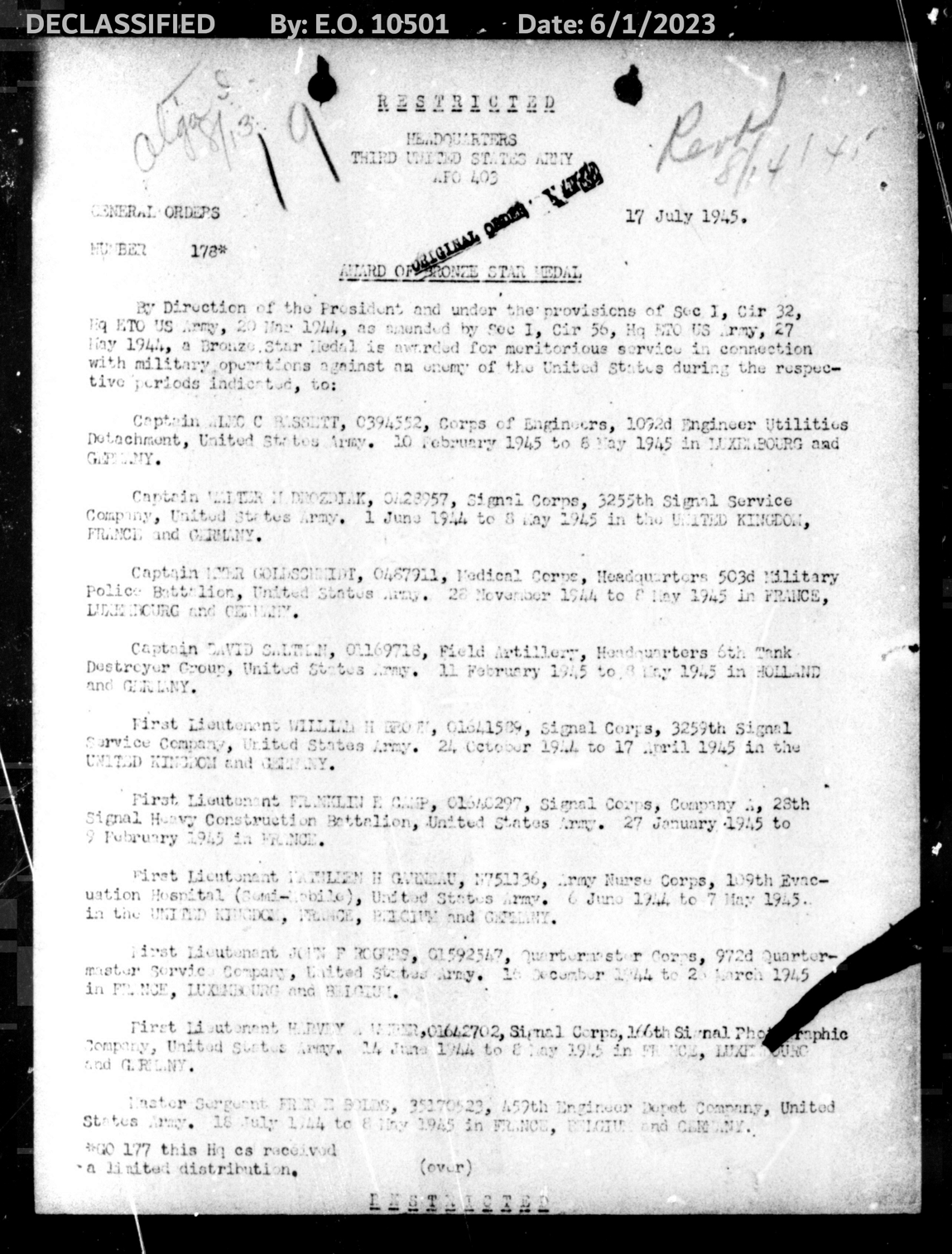
Two months after the war in Europe ended, General Patton's Third U.S. Army published General Orders No. 178 (17 July 1945) awarding the Bronze Star Medal to Captain Walter M. Drozdiak, Signal Corps — commanding officer of the 3255th Signal Service Company, James's discharge unit — for meritorious service “1 June 1944 to 8 May 1945 in the United Kingdom, France and Germany.” The order, found in the recently-OCR'd Third Army general-orders microfilm, names his company in an official Army document and traces the unit's service span — England → France → Germany — across the campaigns stamped on James's discharge. James, an enlisted truck driver, is not named in this officer's-award order; this places and dates his company and identifies the captain who commanded him.
Third Army General Orders No. 178, 17 July 1945: the Bronze Star to “Captain Walter M. Drozdiak … 3255th Signal Service Company … 1 June 1944 to 8 May 1945 in the United Kingdom, France and Germany.”
Source: General Orders No. 178, Headquarters Third U.S. Army, APO 403, 17 July 1945 — Award of Bronze Star Medal (NARA RG 64, Army General Orders microfiche FICHE_89, NAID 356267450, image 0107)
Context / in progress
October 25, 1945
The 3255th stands down in Germany — and the Army's own paperwork calls it a “Radio Intelligence” company
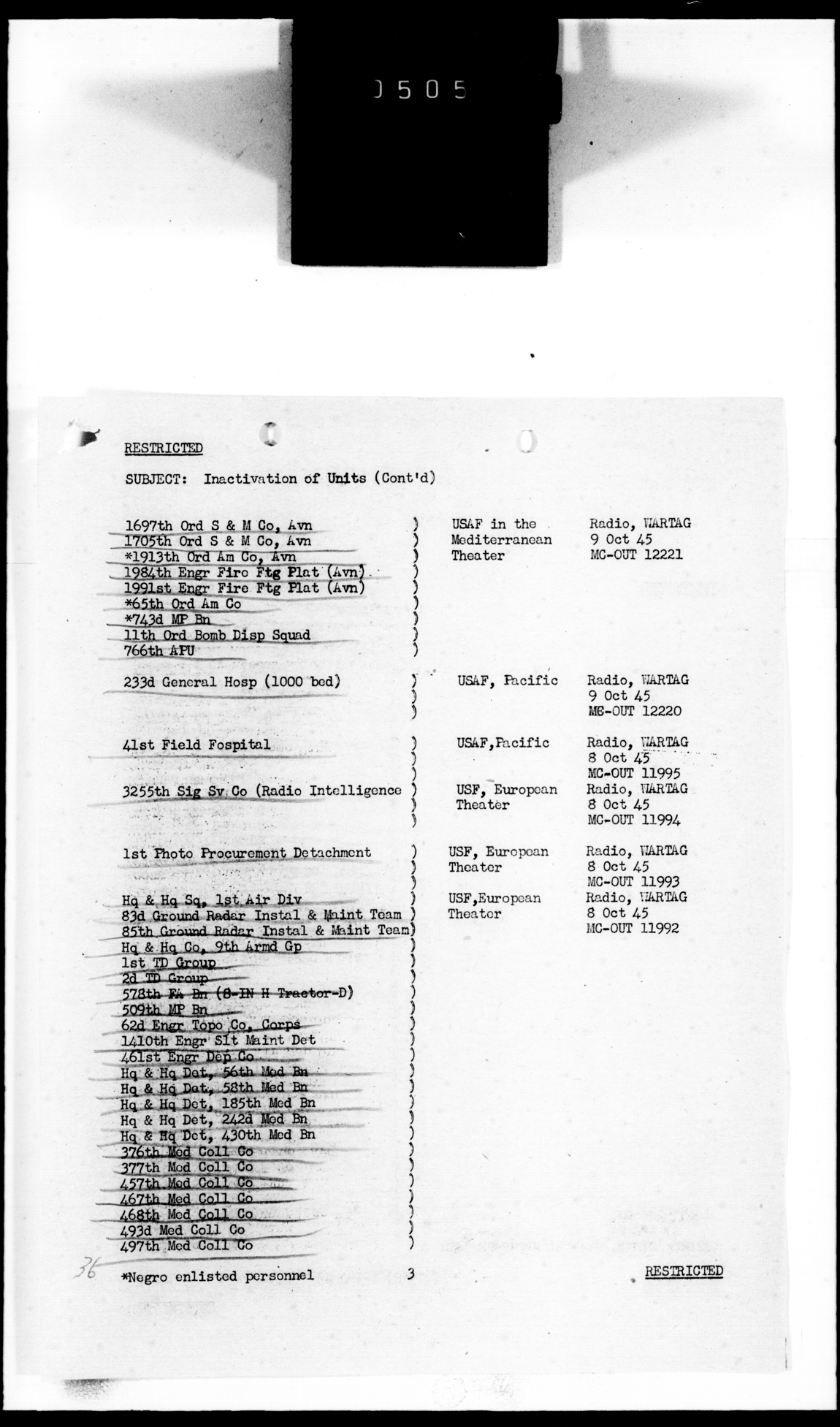
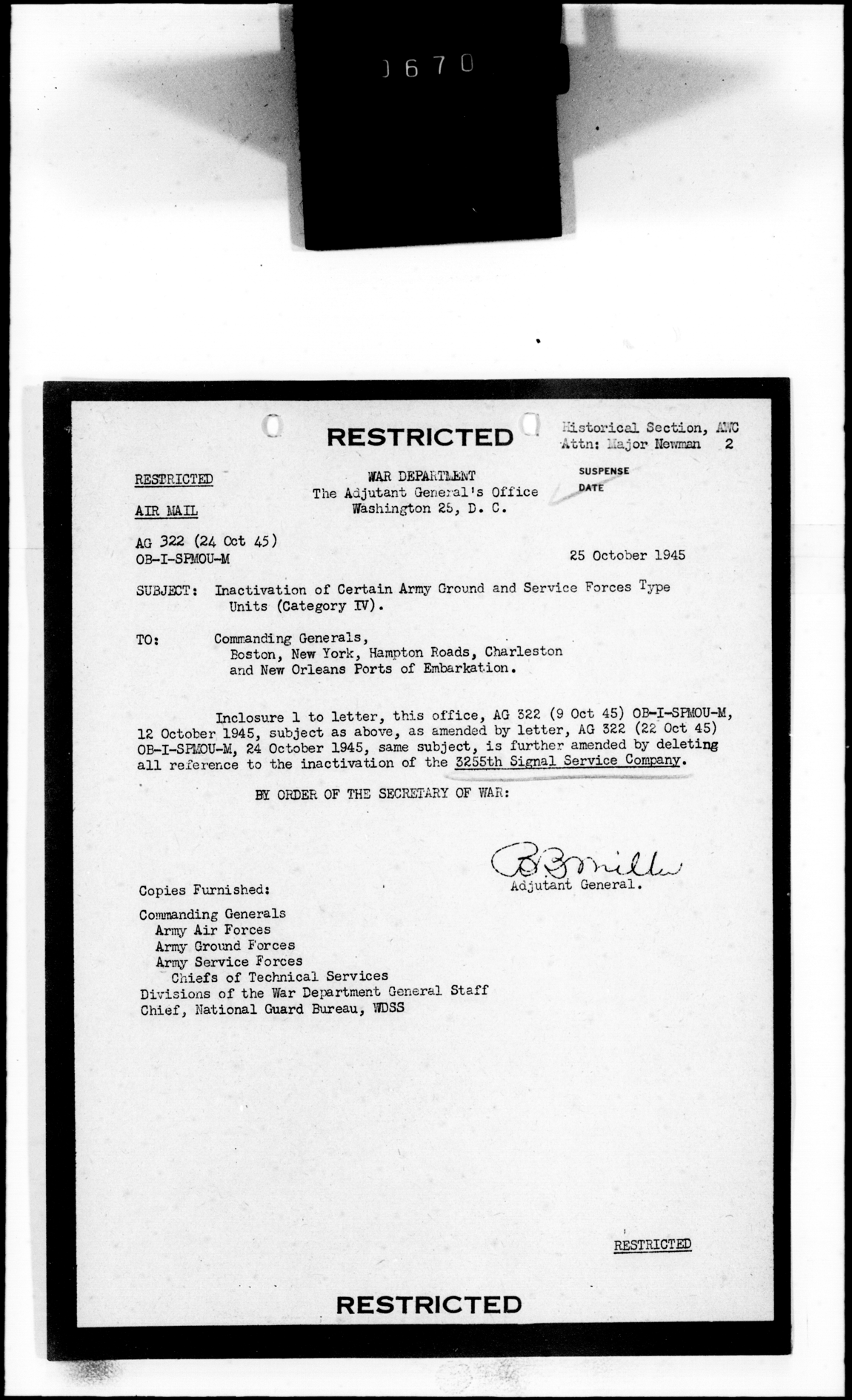
With the war over, James's company was dissolved. War Department inactivation files — newly recovered from the Adjutant General's October 1945 microfilm — pin down both what the unit was and where it ended. A theater inactivation cable lists it as the “3255th Sig Sv Co (Radio Intelligence),” European Theater — the first official War Department document to put the words “Radio Intelligence” on James's discharge unit, confirming in the Army's own hand that his was a signals-intelligence company, not an ordinary communications outfit. A second letter, from The Adjutant General's Office, 25 October 1945, then removes the 3255th from the stateside inactivation list — because the company was being inactivated in Germany itself, not shipped home as a unit to be stood down at a U.S. port. That matches the official Army lineage date: the 3255th Signal Service Company was inactivated 25 October 1945 in Germany. A few weeks later, James began his own journey home. These are unit records, not a personal entry for James — but they document the final fate of the outfit he served in to the end.
A War Department inactivation cable names the unit “3255th Sig Sv Co (Radio Intelligence) — USF, European Theater” — the Army's own label for what James's company did.The Adjutant General's Office, 25 October 1945, amends the orders “by deleting all reference to the inactivation of the 3255th Signal Service Company” — because it was being inactivated in Germany, not at a U.S. port.
Source: War Department inactivation files: theater cable “3255th Sig Sv Co (Radio Intelligence), USF European Theater” and AGO letter AG 322 (24 Oct 45), 25 October 1945, “Inactivation of Certain Army Ground and Service Forces Type Units” (NARA RG 319, microfilm A3701, NAID 636885677, images 0508 and 0673); inactivation date corroborated by U.S. Army CMH lineage, 305th Military Intelligence Battalion
Confirmed — Discharge
December 18, 1945
Departed Europe
After the war's end, began the journey home from Europe.
Source: Honorable Discharge (WD AGO Form 53-55)
Confirmed — Discharge
December 31, 1945
Returned to the United States
Arrived back on American soil to close out his service.
Source: Honorable Discharge (WD AGO Form 53-55)
Confirmed — Discharge
January 5, 1946
Honorably discharged — Camp Atterbury, Indiana
Discharged at the Separation Center, Camp Atterbury, Indiana, as a Technician Fifth Grade (T-5). Awards: EAME Theater Ribbon with 4 bronze battle stars, Good Conduct Medal, and the WWII Victory Medal.
Source: Honorable Discharge (WD AGO Form 53-55)
Family record
1947
Marries Patricia Theisz and settles in Clinton
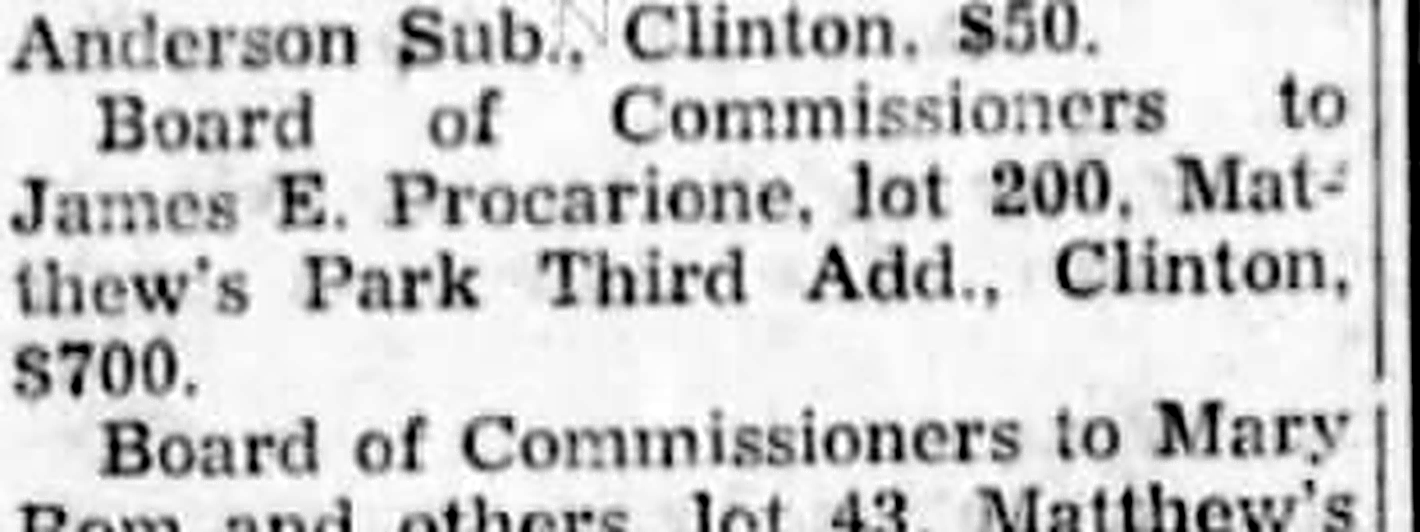
Back in civilian life, James built his future in his hometown. The Daily Clintonian announced his engagement in April 1947 — Patricia Theisz to James, “son of Mr. and Mrs. Domenic Procarione of Clinton” — and on August 30, 1947 he married Patricia Irene Theisz (the marriage was recorded at Rockville on August 29). That October, a county deed notice records the Board of Commissioners conveying Lot 200, Matthew's Park Third Addition, Clinton, to James E. Procarione for $700 — the newlyweds' first home. He would live out his life in Clinton, raising daughters Jamie and Jill. Newly documented.
A Daily Clintonian deed notice, Oct 23, 1947: the county conveys “lot 200, Matthew's Park Third Add., Clinton, $700” to James E. Procarione — the newlyweds' first home.
Source: Engagement notice, The Daily Clintonian, April 9, 1947, p. 3; Indiana Marriages index (James E. Procarione & Patricia Irene Theisz, recorded Aug. 29, 1947, Rockville, Parke Co.); property-transfer notice, The Daily Clintonian, October 23, 1947, p. 4; Find A Grave memorial 106453463
Context / in progress
September 7, 1948
Back home in Clinton — and, in his own hand, “3255th Sig Serv Co”
Nearly three years after his discharge, the postwar draft brings James back to a registration desk in Vermillion County — and this card is the only document in which James himself writes out his own war service. In his handwriting: “ARMY · 35892966 · Sept 7 1943 · 3255th Sig Serv Co · Jan 6 1946.” It is the first time James personally names the 3255th Signal Service Company as his unit — every earlier naming came from the county discharge clerk or a records index — and his own signature closes the card. It also fills in his civilian life: by 1948 he was the circulation manager of the Daily Clintonian, Clinton's hometown newspaper. That corrects the garbled “actor” occupation code on his 1943 enlistment record, and points at that paper as the place to look for a wartime write-up. His description at 23: blue eyes, brown hair, freckled, 5 ft 8 in, 145 lbs. Newly discovered.He filled the card from memory five years on, so his dates run a day off the official discharge, which records entry 8 Sept 1943 and separation 5 Jan 1946.
Source: Selective Service Registration Card (SSS Form 1), Vermillion County, Indiana, registered 7 September 1948 (Fold3 / Ancestry index; NARA RG 147, Korean War-era Draft Registration Cards, 1948–1959)
Family record
1952 – 1972
Community life in Clinton — the Lions Club, and later the miners' union
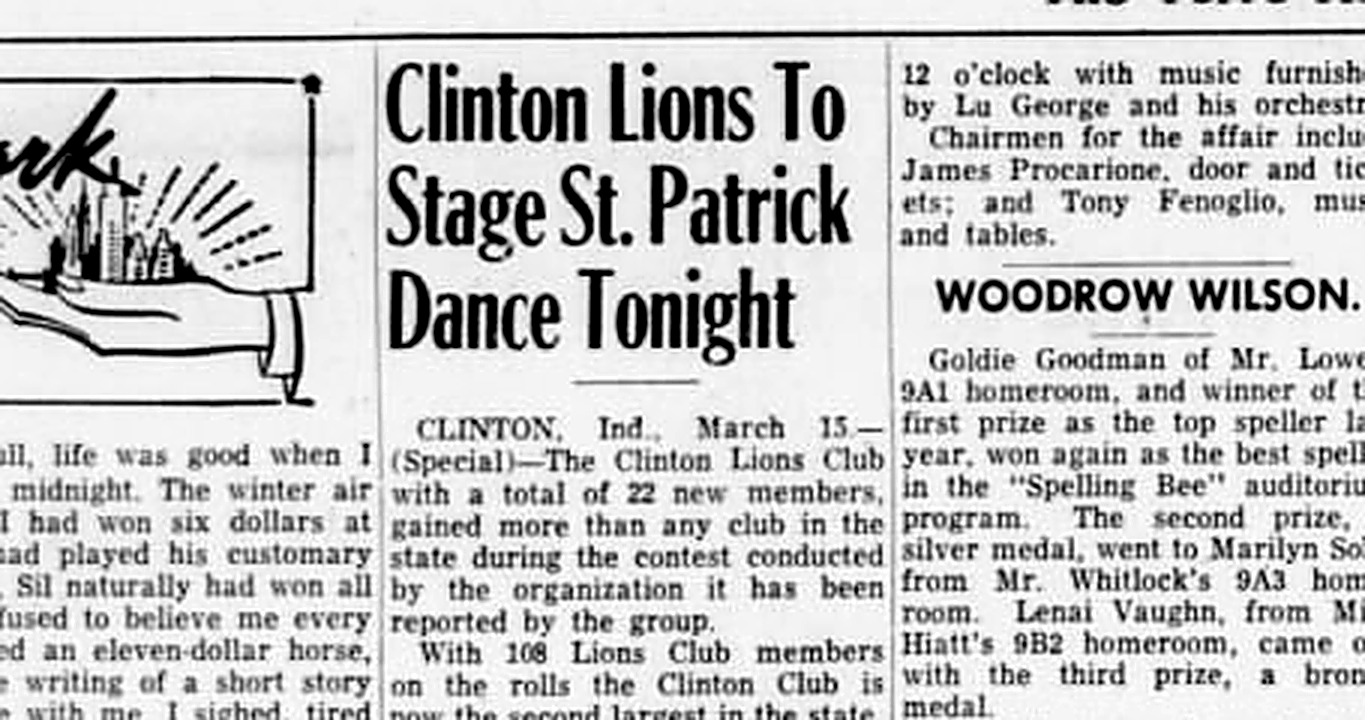
James threw himself into hometown civic life. By 1952 he was active in the Clinton Lions Club — then the second-largest Lions club in Indiana — chairing the door and tickets for its St. Patrick's dance that March, and being elected one of the club's directors for 1952–53, alongside the same Italian-American Clinton families who run through his whole story (Giacoletto, Ricaudia, Giovanini). The coal country claimed him too: a “James Procarione, United Mine Workers representative in District 11,” speaks for Indiana's ~4,500 miners in a November 1972 union-election notice — almost certainly James, in a family rooted in the mines (his wife Patricia was a UMWA secretary). The 1972 union item gives no address, so that identification, while very likely, isn't certain.Newly discovered.
Terre Haute Tribune-Star, March 16, 1952: the Clinton Lions Club's St. Patrick's dance, with “James Procarione, door and tickets.”
Source: “Clinton Lions To Stage St. Patrick Dance Tonight” and Lions Club officers, Terre Haute Tribune-Star, March 16 & May 18, 1952; “In UMW Election,” Terre Haute Tribune, November 14, 1972 (Newspapers.com)
Family record
November 30, 1998
James E. Procarione passes away
He was 73. This timeline is offered in his memory.
His Unit's Story
Public military-history records now let us say what kind of soldier James was, beyond the bare
“Signal Corps” on his discharge. Both units we can place him in were
signals-intelligence outfits — radio-intercept and traffic-analysis teams that listened to the
German army and located its units from their radio signals.
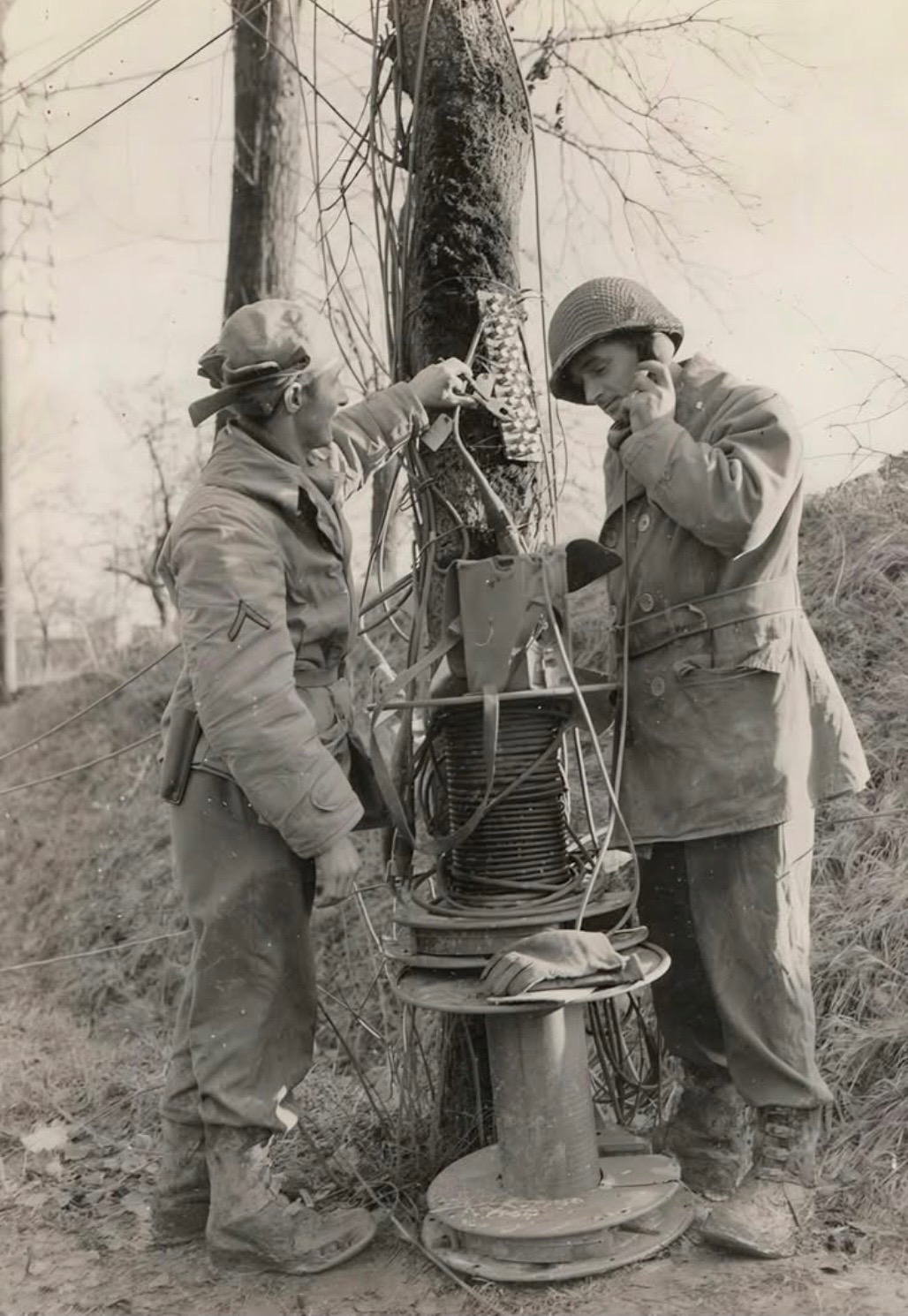
Signal Corps at work: two U.S. Army signalmen run field telephone wire from a reel in the ETO, one testing the line on a field phone. A representative wartime Signal Corps photograph — illustrative of James's branch; not James or the 3255th.
The 118th Signal Radio Intelligence Company — General Patton's “ears”
The unit James joined on 24 April 1944 was the radio intelligence company of the U.S. Third Army
under General George S. Patton. It was activated 20 April 1942 at Fort Sam Houston, Texas, reached England on
29 January 1944, and landed on Utah Beach on 15 July 1944, following Patton's Third Army across France,
through the Battle of the Bulge, and into Germany. Its traffic analysts identified German units from their
radio traffic — the kind of information advantage that let Patton move so fast. An NSA cryptologic
history of Army radio traffic analysis records where the 118th's own war ended —
Stephankirchen, Bavaria, on 20 May 1945 — a village right beside Rosenheim, where the 3255th
finished two days later; James's two units came to rest in the same corner of Bavaria.
A full company history of this unit has been published (see Sources & Further Reading below).
Sources: activation (20 Apr 1942, Fort Sam Houston, TX) — SRH-042, Third Army Radio Intelligence History (Signal Intelligence Service, HQ Third U.S. Army; declassified, NSA) and S. L. French, Not Just Lucky: How Patton's Third Army Adapted to Generate Information Advantage, 1944 (Art of War Papers, Army University Press, 2023) — a book-length study that places the 118th under the Third Army Signal Intelligence Service at Dartford and reproduces a May 1944 photograph of the company; end-of-war station (Stephankirchen, 20 May 1945) — The Origination and Evolution of Radio Traffic Analysis: World War II (NSA Cryptologic Quarterly; declassified 2008, FOIA case 51505), Appendix; also “Signal Units in the Normandy Campaign,” ibiblio.org; D. French, “Gaining the Advantage,” Military Review (Army University Press), Mar–Apr 2022; J. W. DeGrote, The 118th Signal Radio Intelligence Company, 1942–1946 (1998).
The 3255th Signal Service Company — his final unit, a corps code-traffic team
In spring 1944 the Army built a series of small corps-level radio-intelligence companies —
the 3253rd, 3254th, 3255th and 3256th Signal Service Companies — in England, drawn from the men
of radio intelligence companies like the 118th. The Army's official lineage record dates the 3255th precisely:
constituted 12 April 1944 and activated 6 May 1944 in England (inactivated 25 October 1945 in
Germany). James's own records capture this happening: a
27 May 1944 Morning Report of the 118th shows a group (on detached service with the 129th Signal Radio
Intelligence Company) being transferred to the 3255th Signal Service Company — the unit named on
his discharge. The 3255th's wartime record lives on today: its lineage was carried forward into the modern
305th Military Intelligence Battalion, whose official campaign honors —
Northern France, Rhineland, Ardennes-Alsace, and Central Europe — are the same four campaigns
on James's discharge. A 2023 Army University Press study of Patton's intelligence operations states the
corps assignment in print: it lists the four corps companies built that spring — “the 3253rd SSC
was assigned to XV Corps, 3254th SSC to VIII Corps, 3255th SSC to XII Corps, and 3256th SSC to XX
Corps” — and explains that each company (8 officers and 120 enlisted men) supported its corps with
communications-security monitoring and lower-echelon radio intelligence under the Third Army Signal
Intelligence Service. Nall's Veterans History Project interview puts an enlisted voice on the same point: at
Le Mans he remembered the men being told they were the 3255 Signal Service Company, attached to
XII Corps, and that their real work was radio intelligence under a cover story. An
NSA cryptologic history of Army radio traffic analysis settles the assignment in an official reference
table of every Army signals-intelligence company in the European theater: it lists the
3255th — XII Corps, and records where the company's war ended —
Rosenheim, Bavaria, on 22 May 1945, the same Bavarian town his comrade John Hunter's letters and the
published 118th company history independently place the unit. The corps' complete official history
states it in the corps' own voice: “The 3255th Sig Serv Co, a working partner of the 93d Sig Bn,
was assigned to XII Corps by Third Army effective 6 May 44” — the day the unit was
activated — and elsewhere credits it as the unit without which the corps “would have lost valuable
intercepted intelligence.” Its appendices carry the company on every corps station list from
England to V-E Day (radio code name “Habitant”, once even written “3255 Sig Serv Co
RI”) and date the combat attachment: 6 September 1944 to 16 May 1945.
Sources: U.S. Army Center of Military History official Lineage and Honors sheet, 305th Military Intelligence Battalion (the 3255th's successor — gives the 12 April 1944 / 6 May 1944 dates); S. L. French, Not Just Lucky: How Patton's Third Army Adapted to Generate Information Advantage, 1944 (Army University Press, 2023), pp. 50–51 (names the 3255th’s assignment to XII Corps); Lt Col George Dyer, XII Corps: Spearhead of Patton's Third Army (1947), p. 108 (“assigned … effective 6 May 44”), p. 130 (“intercepted intelligence”), Appendix A station lists and Appendix B attachment dates; The Origination and Evolution of Radio Traffic Analysis: World War II (NSA Cryptologic Quarterly; declassified 2008, FOIA case 51505), Appendix — tabulates every Army SIGINT company in the ETO and lists the 3255th under XII Corps, “ended at Rosenheim, 22/5/1945”; CMH, Signals Intelligence in World War II (CMH Pub 70-43) and the “Intelligence in the Field” lineage series; “Signal Units in the Normandy Campaign,” ibiblio.org; 118th Sig. R.I. Co. Morning Report, 27 May 1944 (NARA Roll 493); Carl K. Nall LOC VHP oral-history interview/transcript, 00:35:15–00:36:37.
What this means for James
His discharge calls him a light truck driver (MOS 345) in the Signal Corps — true, but it
undersells the company he kept. From April 1944 to the end of the war he served in tactical
signals-intelligence units in the European campaign: first the 118th Radio Intelligence Company
(Patton's Third Army's own), then the corps-level 3255th. He drove and supported a team whose mission was to
intercept and read the enemy's radio traffic — carrying it across Northern France, the Ardennes, the
Rhineland, and into the heart of Germany.
Inside His Company — From the Published History
The veterans of the 118th wrote their own story. We obtained and read the published history of
James's April–July 1944 company — World War II: Perception to Reality by
Stanley K. Scott and John De Grote — and it brings the bare records to life, describing week by
week how this radio-intelligence company lived, moved, and did its work.
The Signal Corps truck driver's job
James's discharge lists his job as light truck driver (MOS 345). The company history shows what
that meant day to day. The 118th was a small fleet on wheels — Jeeps, weapons carriers,
and GMC 2½-ton trucks carrying the radios, the heavy PE-95 power generators on
trailers, and the kitchen, headquarters and supply. Its radio-intercept and direction-finding teams
set up ten to twenty miles out toward the front, and a driver was assigned to each one: he ran back
to the company area for supplies and mail, ferried men back and forth, and pitched in on chow and camp work.
That is the role James filled — the man who kept a signals-intelligence team supplied and moving as it
leap-frogged across Europe.
Source: Stanley K. Scott & John De Grote, World War II: Perception to Reality — 118th Signal Radio Co, Third US Army, WWII (2018), the company's published history (its “Motor Pool” and “Direction Finder” chapters).
The same road, town by town
The book traces the 118th from Camp Forrest, Tennessee to Vint Hill Farms, Virginia, across to
England (arriving 30 January 1944), down to Dartford in Kent, then out through
Seaton, Devon — which it left on 10 July 1944 for the Channel crossing, the same move
James's own Morning Reports record (above). From Normandy it followed Patton's Third Army east across France,
wintered in Luxembourg through the Battle of the Bulge, crossed the Rhine at Oppenheim, and
finished the war on occupation duty at Rosenheim in Bavaria — independently, the same waypoints
the 3255th's own records and his comrades' letters describe. The history closes the way James's service did:
nearly every man of the company was home for Christmas 1945.
Source: Scott & De Grote (2018), narrative chapters — corroborates the Morning Reports, the SRH-042 war diary, and the Hunter/Olds/Nall accounts cited elsewhere on this page.
Why James isn't named in it
We searched the whole book for James — by name and by service number — and read every one of its
platoon rosters. He is not listed, and that takes nothing away from his record. The authors rebuilt
those rosters decades later from memory — from questionnaires and interviews with the company's
long-serving original members — and say so plainly. James came to the 118th as a
late replacement in April 1944 and was moved on to the 3255th within about three months — too
briefly to land on a list built from veterans' recollections. His own Army Morning Reports, found by his
service number, place him in the company; the book tells us what life there was like.
His Company's Own War Diary
The U.S. Third Army's own secret Radio Intelligence History (SRH-042) — classified during the war and
later declassified by the National Security Agency — preserves the 3255th Signal Service Company's
monthly operational reports, each signed by its commanding officer, Capt. Walter M. Drozdiak. They
record, month by month, where James's company was as it followed XII Corps across Europe — filling
in the campaign year the online Morning Reports (which stop at December 1944) do not reach.
These are the company's own positions; the reports name the unit, not its individual drivers,
so they place James's company — and therefore James, carried on its rolls — rather than naming
him personally.
Where the 3255th was, in its own words
November 1944 — Lorraine, France. The company operated around Armaucourt and
Gremecey, northeast of Nancy, running its wire lines into XII Corps as the Third Army ground toward
the Saar.
December 1944 — into Luxembourg (the Bulge). Its December report covers operations
near Morhange and Sarralbe, France, and Kirchberg, Luxembourg — the company's own record,
independently confirming Lt. Olds's account of pulling into Kirchberg on snowy 23 December 1944.
February 1945 — Waldbillig, Luxembourg. The company was at Waldbillig, with XII Corps
headquarters just up the road at Fels, as the front pushed toward the Siegfried Line and the Rhine.
April 1945 — into Germany. Now operating inside Germany, on 21 April 1945 the company
moved up to support the 90th Infantry Division at Langenzenn (near Nuremberg), tracking German panzer
units toward the Czechoslovak border.
May 1945 — Germany to V-E Day. Its final operational report covers operations in Germany
through the war's end, as XII Corps drove to the Danube, Linz, and the edge of Czechoslovakia,
meeting the Red Army at the surrender on 8–9 May 1945.
His discharge named the 3255th but said nothing of where it went. These
signed company reports now trace his unit's path month by month through the otherwise-blank campaign year
— the same towns Lt. Olds remembered and the same XII Corps route the corps history records —
placing James's company, and its light-truck driver, in Lorraine in the fall of 1944, in Luxembourg for the
Bulge, and across Germany to V-E Day.
Source: SRH-042, Third Army Radio Intelligence History in the Campaign of Western Europe
(Signal Intelligence Service, Headquarters Third U.S. Army; declassified, NSA) — the 3255th Signal Service
Company monthly Unit Operational History reports, Nov 1944 – May 1945, signed Capt. W. M. Drozdiak;
corroborated by American Signal Intelligence in Northwest Africa and Western Europe (U.S. Cryptologic
History, NSA).
His company kept its own daily Journal — and it survives at the National Archives
In July 2026 the National Archives at College Park confirmed a discovery that reopens the whole campaign year:
the 3255th Signal Service Company's own operational records survive intact. The 1973 fire that destroyed
James's personnel file never touched these — that blaze consumed individual personnel records, while
these are the unit's operational records, stored in a wholly separate archive — and between them they
span almost exactly the months his burned file can no longer account for. Two files sit together in
Record Group 407, the Adjutant General's World War II Operations Reports, in Box 18442 at Archives II
in College Park, Maryland:
The company Journal (file SGCO-3255-0.7) — the unit's running daily log, about 79 pages,
opening on 6 May 1944, the day the 3255th was activated in England, and closing on
8 May 1945, V-E Day. Because it begins on the company's first day, it covers the late-May 1944 weeks
when men of the 118th Signal Radio Intelligence Company — James among them — were transferred in
and absorbed into the new company: the exact administrative moment that turned a 118th replacement into a
3255th soldier, and the seam his records have never crossed.
The company Operations Report (file SGCO-3255-0.3) — about 140 pages covering
24 August 1944 to 12 May 1945, from the breakout and the race across France, through the Lorraine and
Rhineland fighting and the Battle of the Bulge, across the Rhine, and on to the German surrender.
Together that is roughly 220 pages of the 3255th's own day-by-day account of the war — the single most
promising un-read source left for placing James personally inside his discharge unit.
Source: National Archives at College Park — RG 407, World War II Operations Reports,
1940–1948 (Entry NM-3 427), Box 18442: files SGCO-3255-0.3 (Operations Report, 24 Aug 1944 – 12 May
1945, ~140 pp.) and SGCO-3255-0.7 (Journal, 6 May 1944 – 8 May 1945, ~79 pp.).
What these pages can still reveal — and how they were found
A company journal and operations report are written day by day, in the field. They record the unit's strength
and station each day, the men who join, leave, are promoted, fall sick, or are detached, and what the
company did — where it set up its radio work, whom it supported, and when it moved. That is
the level of detail James's story loses after December 1944, where the digitized Morning Reports run out.
These pages could answer the questions his burned file cannot: the day James's name first appears on the
3255th's own rolls, his promotion to Technician Fifth Grade, the paperwork of his transfer in from the
118th, his movements through the 1945 campaigns, and his processing to sail home in December 1945.
The lead came from the National Archives' Textual Reference staff, who located the two files and pointed to a
digitized finding-aid index for the series — a set of catalog cards, scanned and browsable online.
That index was pulled up and read directly: the 3255th's card (sitting one page apart from the neighboring
3254th and 3256th companies, which confirms it is the right unit) is the source of the precise dates and the
hand-noted page counts above. The records themselves, though, are not digitized — they exist
only on paper at College Park, and the series has no name index, so finding James in them means reading the
pages one by one. The family is now arranging to obtain copies.
Source: National Archives at College Park, Textual Reference Branch, reference reply, 9 July 2026;
digitized index to the WWII Operations Reports, NAID 483324851, object page 358 (3255th Signal Service Company
index card, read online).
A Comrade's Account
One of the six lieutenants of James's discharge unit — the 3255th Signal Service Company —
left a firsthand memoir of the company's war. Lt. (later Capt.) David Mark Olds helped assemble the
company in England, crossed to France with it, and wrote down where it went and what it did, from the south
coast of England through the Battle of the Bulge and into Germany. It is the story of James's
own company — told by one of its officers.
The memoir and the Army's records confirm each other
Olds's account lines up, point for point, with the Morning Reports we found for James's unit. He names the
company's commanding officer as Captain Walter Drozdiak — and it is Drozdiak's signature
that appears on the 3255th's own Morning Report of 9–10 June 1944. He describes the company being
assembled at Eastbourne on the English south coast alongside a “host” unit, the
129th Radio Intelligence Company — the same 129th named in James's 27 May 1944
transfer record. And he states that the company was “assigned administratively to the
XII Corps, a part of the Third Army commanded by General Manton S. Eddy” — independent,
firsthand confirmation of the corps his unit served. From Utah Beach through Nancy, Luxembourg, the Rhine
and into Germany, Olds traces the exact four campaigns stamped on James's discharge. His complete memoir,
published online by his daughter Dorri Olds, is the closest thing we have to an account of
James's own war.
Sources: Capt. David Mark Olds, WWII memoir (dorriolds.com); New-York Historical Society, David Mark Olds World War II Collection (PR-287); 3255th Sig. Sv. Co. Morning Report, 9–10 June 1944 (NARA Roll 736); 118th Sig. R.I. Co. Morning Report, 27 May 1944 (NARA Roll 493).
A Fellow T-5's Interview
The Library of Congress interview with Carl K. Nall adds an enlisted man's voice to the paper trail.
Nall was, like James, a Technician Fifth Grade in the 3255th Signal Service Company. He does not
name James personally, but he describes the same small company, the same XII Corps assignment, and the same
route that James's discharge and unit records point to.
What Nall adds to James's story
Nall's interview puts the official records on the ground: a small radio-intelligence outfit moving with Patton's Third Army, using a cover
identity while its intercept, direction-finding, and control teams tracked German radio traffic.
✓Unit and command, stated plainly. At Le Mans, Nall remembered
the men being told they were the “3255 Signal Service Company, attached to XII Corps”
(00:35:15–00:35:18).
✓How the work was organized. He describes three men assigned to
the control hut, two direction finders, radio-truck intercept men, and a cover story that
the men were doing radio repair if questioned (00:35:38–00:42:37).
✓The Normandy-to-Lorraine route. He places the unit at
Utah Beach at 2200 hours on 12 August 1944, then moving past Saint-Lô to
Le Mans, and later into Nancy at the end of September (00:29:07–00:35:18;
00:45:25–00:46:00).
✓Late-war company context. He mentions Lt. Bateman,
places the company at Rosenheim, and recalls being sent to Corps headquarters for teletype duty
after the shooting stopped (01:02:43–01:08:03).
✓Photos and map shown on camera. Starting about 01:24:11,
Nall walks through unit photographs and identifies men including Paul Yeager, Sergeant Hunter, Ward,
Dunn, Monahan, Kohler, and Nall himself. At 01:26:36 he shows the route map through Utah Beach,
Saint-Lô, Bar-le-Duc, Nancy, Luxembourg/Bastogne, Frankfurt, and Neudorf.
How to use this evidence. Nall's interview should be treated as company-level corroboration, not a
personal sighting of James. It strengthens the story of what the 3255th was, where it went, and how it
worked; it does not prove James was in any specific photograph unless a separate roster, caption, or
identification turns up.
Sources: Carl K. Nall Collection, Library of Congress Veterans History Project, item afc2001001.38297; local project transcript oral_histories/Nall_CarlK_LOC_VHP_afc2001001-38297_transcript.md; James E. Procarione discharge; 3255th Signal Service Company operational records in SRH-042.
Sources & Further Reading
Published history of his April 1944 unit
John W. DeGrote, The 118th Signal Radio Intelligence Company, 1942–1946, Third US Army,
World War II (self-published, 1998) — a full company history of the unit James joined in
April 1944. It is a print book (not free online); copies are held by libraries including the
Imperial War Museums and are catalogued on WorldCat and Open Library, with used copies through
AbeBooks and Amazon.
A later, in-print edition drawn from the same material: Jeri Lynn Scott & John W. De Grote,
World War II Perception and Reality: 118th Signal Radio Co Third US Army WWII
(2018, ISBN 978-1-9830-8050-0) — available on Amazon as a paperback and Kindle e-book.
A copy has now been obtained and read in full for this project; what it adds about James's
company is drawn together above under “Inside His Company — From the Published History.”
Records & references used
James E. Procarione, Honorable Discharge (WD AGO Form 53-55), recorded Vermillion County, Indiana, 17 Jan 1946.
U.S. Army Morning Reports (WD AGO Form 1), NARA series 85713825, searched by service number 35 892 966 — Rolls 66, 460, 656, 596, 493, 736, 565.
“Signal Units in the Normandy Campaign,” ibiblio.org/cizewski/signalcorps.
U.S. Army Center of Military History: Signals Intelligence in World War II (CMH Pub 70-43) and the “Intelligence in the Field” lineage series.
Spencer L. French, Not Just Lucky: How Patton's Third Army Adapted to Generate Information Advantage, 1944 (Art of War Papers, Army University Press / Combined Arms Center, Fort Leavenworth, 2023) — a free book-length study that names the 3255th Signal Service Company's assignment to XII Corps and reproduces a May 1944 photograph of the 118th Radio Intelligence Company at Dartford.
D. French, “Gaining the Advantage: How Patton's Unique …,” Military Review, Army University Press, Mar–Apr 2022.
U.S. Army Center of Military History, official Lineage and Honors sheet, “305th Military Intelligence Battalion” (history.army.mil) — the modern successor of the 3255th Signal Service Company; records the 3255th as constituted 12 April 1944 and activated 6 May 1944 in England.
SRH-042, Third Army Radio Intelligence History in the Campaign of Western Europe (Signal Intelligence Service, Headquarters Third U.S. Army; wartime SECRET, since declassified by the National Security Agency) — contains the 3255th Signal Service Company's monthly operational reports (Nov 1944 – May 1945), each signed by Capt. W. M. Drozdiak, tracing James's company across Lorraine, Luxembourg, and Germany.
American Signal Intelligence in Northwest Africa and Western Europe (United States Cryptologic History, Series IV, World War II, Vol. 1; National Security Agency) — the published operational history of the corps radio-intelligence companies, including the 3255th (code-name “Sombrero”) and its assignment to XII Corps.
The Origination and Evolution of Radio Traffic Analysis: World War II (National Security Agency, Cryptologic Quarterly; declassified 16 June 2008, FOIA case 51505) — an NSA history whose Appendix tabulates every Army signals-intelligence company in the European theater with the corps it served and where its war ended; it lists the 3255th under XII Corps, “ended at Rosenheim, 22/5/1945,” and the 118th under Third U.S. Army, “ended Stephankirchen, 20/5,” and dates the 118th’s arrival in England to 11 January 1944.
James L. Gilbert & John P. Finnegan, eds., U.S. Army Signals Intelligence in World War II: A Documentary History (Center of Military History, U.S. Army, 1993) — reproduces portions of SRH-042 and the Third Army radio-intelligence record.
Capt. David Mark Olds, WWII memoir (PDF, published by his daughter Dorri Olds) — a firsthand account by an officer of the 3255th Signal Service Company, James's discharge unit.
Lt Col George Dyer, XII Corps: Spearhead of Patton's Third Army (XII Corps History Association, 1947) — the corps' official history; names the 3255th Signal Service Company as one of the two signal units running XII Corps headquarters' message and signal centers, dates its assignment (“effective 6 May 44”), and credits it with the corps' “intercepted intelligence.” The complete edition (Ike Skelton Combined Arms Research Library digital collection) adds the appendices: the corps' SECRET station lists carrying the 3255th — code name “Habitant” — from England to V-E Day, and the unit attachment record “6 Sep 44 – 16 May 45.”
Carl K. Nall Collection, Library of Congress Veterans History Project (item afc2001001.38297; LOC video file) — a fellow Technician Five of the 3255th Signal Service Company, catalogued under “3255th Signal Service Company, XII Corps, 3rd Army.” The project transcript now identifies his direct unit confirmation at 00:35:15 and his photo/map discussion at about 01:24:11–01:28:09.
A fellow soldier of the 3255th
How David Mark Olds connects to James
David Mark Olds was a young Signal Corps officer from the Bronx. Like James, he trained at the
Army's secret signals-intelligence school at Vint Hill Farms, Virginia, then shipped to England.
In the spring of 1944 he was ordered to a brand-new outfit: “I was ordered to the newly activated
3255 Signal Service Company, the cover name for a radio intelligence company.” That is the unit
named on James's discharge.
What we can prove
✓Same company. James's discharge gives his final unit as the
3255th Signal Service Company. Olds served in the 3255th from the day it was formed until the war's end.
It was tiny — Olds puts the whole company at about 110 men — small enough that its
handful of officers knew the men.
✓The records back up the memoir. Olds names the C.O. as
Capt. Walter Drozdiak; Drozdiak's signature is on the 3255th's own Morning Report (June 1944),
and his name — with those of other officers Olds describes (Bateman, Kephart, Patenaude) —
recurs on the company's report pages from June through December 1944.
✓The same 129th, the same Eastbourne. Olds says the 3255th was
built at Eastbourne with the 129th Radio Intelligence Company as its host. James's 27 May 1944
transfer record routes his group through that exact 129th into the 3255th.
✓The same higher command. Olds: the 3255th was
“assigned administratively to the XII Corps… Third Army… General
Manton S. Eddy.” James's own records tie both his units to Third Army, and the campaign
geography matches XII Corps exactly.
✓The same four campaigns. Olds's route — Utah Beach,
the drive across France, Nancy, the Bulge in Luxembourg, the Rhine, and into Germany — traces the
very campaigns on James's discharge: Northern France, Rhineland, Ardennes, Central Europe.
What we can't prove (yet)
We have not yet found a single document that lists both men on the same page on the same day.
James appears by name in the records up to April 1944 (in the 118th), and then only inside group
transfers into the 3255th; his individual paperwork inside the 3255th — and the 1945 records that
would name him there — were not digitized and survive only on microfilm in St. Louis or in the
company's own files. James and David Olds served in the same small
company, which moved as one unit; once James was carried on its rolls he was wherever Olds's company
was — Nancy in the fall of 1944, Kirchberg in Luxembourg for the Bulge, across the Rhine into
Germany in 1945. Olds's memoir is the closest thing we have to James's own war diary, written by a
man who lived it beside him.
A note on dates. Olds wrote from memory decades later and warned that his dates were fuzzy. Where
his memoir and the Army's day-by-day Morning Reports disagree on timing — for instance, he recalls
landing in Normandy about two weeks after D-Day, while the reports place the 3255th still assembling in
England in early June and crossing to France around late July 1944 — we trust the contemporary
reports for when, and use Olds for the texture of what those months were like.
Where this leads next
Olds kept photographs and papers, now held at the New-York Historical Society (the
David Mark
Olds WWII Collection, PR-287). Its catalog lists photographs of soldiers taken in France (1944)
and Germany, and a “Journal of the 3255 Signal Service Company in Europe, 44/45.”
A company journal and pictures of its men are the most promising place yet to find James — the
company driver — named or photographed. Olds's memoir is
published online
by his daughter, Dorri Olds, who may hold
further records of her father's company.
The family behind the soldier
James Procarione — Family Tree
Beyond his Army service, here is who James came from and who came after him — five
generations, from immigrant great-grandparents in Italy and Hungary down to James's
grandchildren. It was rebuilt from a sourced WikiTree family cluster, obituaries, and
census & death-certificate transcriptions. (Full citations and confidence levels:
Procarione_Genealogy_FamilyTree.md.)
The family at a glance
Paternal · ItalyMaternal · HungaryJames
Grandparents · Locana, Piedmont → Wakefield, MI
Carlo Procarione&Catherine Procarione
Grandparents · Hungary → Clinton, IN (1892)
Andrew F. Vargo1868–1956&Mary Reginac.1877–1950
Parents
Domenick V. Procarione1900–1966m. 1925Julia Vargo1909–1986
James Eugene Procarione1925–1998m. 1947Patricia Irene Theisz1927–2009
Domenick V. Procarione (father), 1900–1966. Born April 7, 1900 in
Wakefield, Michigan (a mining town his Italian immigrant parents had reached by then);
died Dec 24, 1966 at Terre Haute, Indiana; buried Walnut Grove Cemetery, Clinton.
A laborer; married Julia Vargo in 1925. Confirmed
Julia (Vargo) Procarione (mother), 1909–1986. Born Feb 12, 1909 in
Clinton, Indiana, into the Hungarian Vargo immigrant family; died May 31, 1986. She is the
“Mrs. Dominic Procarione” named in her brother's 1956 obituary.
Confirmed
His grandparents
Carlo Procarione & Catherine Procarione (paternal). Italian immigrants from
Locana, Province of Turin, Piedmont, who settled via Wakefield, Michigan. Named on
Domenick's Indiana death certificate. Exact dates not yet found — the paternal frontier.
Names confirmedLocana origin probable
Andrew Frank “Andy” Vargo (maternal grandfather), 1868–1956. Born
in the Austro-Hungarian Empire; immigrated to New York April 6, 1892 (“Andras
Vargo”); settled at Clinton, Indiana. Confirmed
Mary Regina (Pálfi?) Vargo (maternal grandmother), c. 1877–1950. Born in
Hungary; married Andrew in 1900. Maiden name not yet settled.
Maiden name probable
The immigrant frontier (great-grandparents)
The line currently reaches back to the immigrant generation on both sides. Carlo Procarione's
parents in Locana, Italy, and Andy & Mary Vargo's parents in Hungary, are the
next walls to break — via Italian civil registers (Locana), the 1892 Vargo ship manifest, and the
Wakefield, Michigan census.
His sister
Rosemary (Procarione) Miethe, 1928–1998 (born Clinton; died Ladoga, Indiana) —
James's only known sibling. Confirmed
His wife & her family
Patricia Irene (Theisz) Procarione, 1927–2009. Born Feb 8, 1927,
Clinton; married James Aug 30, 1947; secretary for the United Mine Workers of America;
buried Walnut Grove Cemetery. Confirmed
Frank Theisz (her father, c. 1896–1970, b. Hungary) and
Violet M. (Rhoads) Theisz (her mother, 1900–1977, b. Indiana).
Probable
His children & grandchildren
Jamie (Procarione) Thompson — m. Cliff Thompson (Indianapolis). Daughters
Julia and Kelly Thompson. Confirmed
Jill (Procarione) Andrews — m. Virgil Andrews (Clinton). Granddaughters
Holly and Kelsie Uselman. Uselman line probable
How this was built & a note on sources. The data and photographs come from the family's
WikiTree profiles (Procarione‑1/2/3, Vargo‑78/84), obituaries (Terre Haute
Tribune Star), and transcribed census & death-certificate records, all archived to the
Wayback Machine for permanence. Find A Grave is omitted on purpose — it blocks both
direct access and the Internet Archive crawler, so it could not be used or preserved. Living
descendants are listed only as named in public obituaries. “Probable” means indexed but not
yet confirmed against a primary image.